

The Human Touch vs. The Algorithm: 10 Truths About AI Real Estate Photo Editing

The ideal picture brings someone who will say, “I’d love to look at that house!”
AI editing tools is fast and brings a new dimension to photo editing due to its brilliant intelligence. While human editors provide that magic touch, they are masters at their craft and do a great job; therefore, instead of comparing which is better, this guide compares AI photo editing for real estate vs human, discusses how they each work and when is the best to use one or the other for producing the best possible property listing photos.
Once you have all of this information, you will be able to create property listing photos that will show off your properties in the best light possible.
Table of Contents
What Is AI Real Estate Photo Editing?
Let’s kick things off with some definitions about what AI real estate photo editing is. The simple answer is, it’s not a figment of science fiction but rather an existent tool quietly making property pictures fabulous on the internet today; it uses clever computer programs (AI) trained on innumerable quality real-estate-property pictures.
Picture a situation in which you snap off pictures as fast as possible in the morning. Right after you take a picture, you upload it to an AI photo editor for real estate. In only seconds. The AI photo editing for real estate tool straightens out straight lines, adjusts the bright and dark areas of the photo, removes minor distractions (a toy or something) from the background of the picture, and may even provide you with virtual staging options.
AI photo editing not only edits quickly, but it also creates uniformity of appearance to all of your pictures. If you have multiple pictures for one listing, AI photo editing for real estate will finish all of them in the same polished way, so your portfolio appears cohesive. For example, no longer will one image of a room seem to have more natural light in it than another room image taken at the same time.
No, it isn’t actually “magic”. AI real estate photo editing uses patterns to learn how to make a home look nice and how to use natural light to your advantage without overexposing colors, but it cannot “feel” a house like a human would when visiting.
How AI Real Estate Photo Editing Actually Works
To get a better understanding of how AI real estate image editing works, we can take a look at how these computer programs perform their functions. The vast majority of AI photo editing for real estate tools use machine learning to function. In simple terms, they learn from large numbers of different examples (think of a large collection of real estate photographs).
What AI Learns While Editing Real Estate Images
Learning Features: As a first step, the AI learns common objects in a real estate image, such as a wall, ceiling, floor, window, and sky. The AI knows the normal appearance of these items and how they commonly fit together.
Identifying Patterns: Lastly, it learns from an editor’s example of how professional editors alter these things. These include making sure vertical lines are straight, using vibrant yet natural colors, adjusting shadows in rooms to appear brighter, and changing boring-looking skies to more beautiful ones.
When you upload your image, AI photo editing uses its knowledge to perform these functions: Lines: It automatically keeps all walls and doors perfectly straight in the final image, which is essential in real estate photos. Enhanced Brightness (High Dynamic Range).
Color Correction: Color correction allows you to make the colors appear natural and eliminates any unusual tinting of a color (such as yellow-tinted light coming from indoor light). Removing Items: Some types of advanced AI photo editing technology can identify and erase small distractions (for example, a garbage can or garden hose) from an image.
Sky Swaps: You can change out a dull/boring gray sky with a vivid blue sky, often even adjusting the light from the rest of the image to be in line with this new sky. Virtual Staging (A newer option):
AI real estate photo editing is able to perform complicated tasks quickly and for many images, mimicking what competent editors do without requiring a person to perform each step, which results in a high level of consistency and efficiency in real estate.
The Classic Art of Human Photo Editing (Where Feelings and Skill Meet)
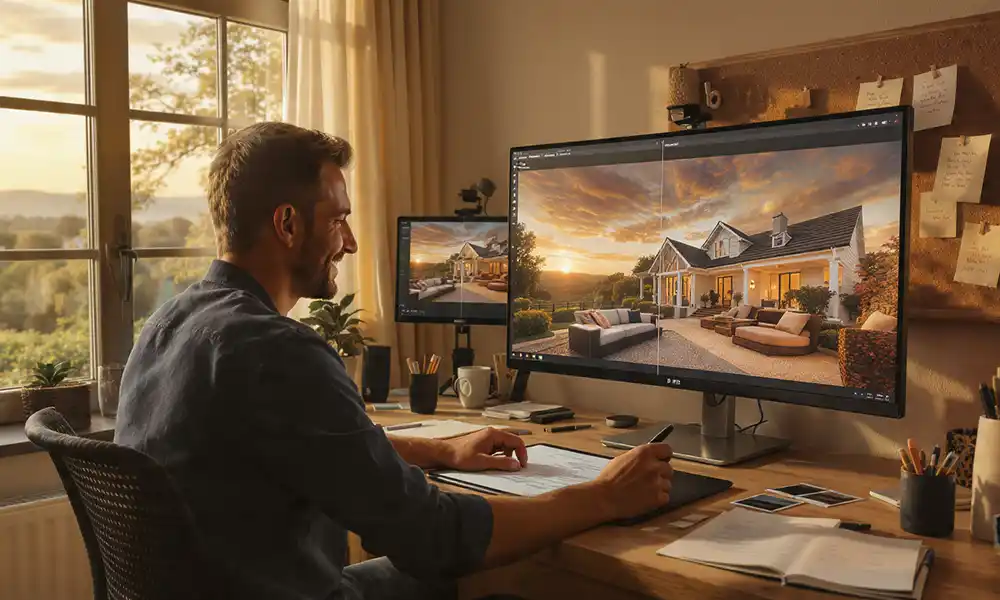
Let’s examine the human aspect of this. An automated process cannot completely replicate the human element; it comes from the editors’ instincts, feelings, and personal touch. They may have been on the property, discussed the property’s special features with the owner, and know what specific details will captivate buyers.
Consider a company such as Pixelshouters – A group of highly skilled individuals that treats every photo as if it were a piece of art. Instead of simply brightening a room, they consider the colour of the light in the room, the texture on the cabinets, and the story of the house.
AI photo editing can do the fundamentals very well, whereas humans have the ability to see beyond what AI sees. When selling homes in a specific location, people know that potential buyers have different preferences (i.e., a cozy atmosphere for a family home compared to a polished, contemporary look for an apartment in the city).
Humans do not tend to work slowly. They invest time in order to make sure the result has the desired impact. An agent who thought he would not spend an hour creating an immaculate twilight photograph found he had more opportunities to use that photograph to expose his listing to many times more people than he otherwise would have.
The Human Connection: Beyond Just Pushing Buttons
Human editors do not merely make quick, superficial edits; instead, they apply the many years of expertise that they have developed over many years. They combine their training with a fine-tuned eye and a rich knowledge of design and aesthetics to develop a high-quality product.
What a Human Editor Does (A Skilled Process)
Using the Vision Guide: A human editor begins by assembling the entire shoot and identifying the unique features of the home, as well as the home buyer. With the finished pictures, the editor will have created a visual representation of the property.
More Advanced Fixing and Combining: Removing Problematic Objects: A human can carefully remove large distracting items from a photo and recreate the background perfectly without having any blurred areas, while an AI real estate photo editor may have difficulty removing a large object (such as construction vehicles or complex electrical cables) from an image that may have a complicated background.
While AI real estate editing has developed the ability to change the sky in a photo, it will still take an editorial touch of a real person to ensure that the colour, light and mood of the new sky match the other elements in the image so that it looks believable. They’ll also ensure that window reflections match, too.
Mood Through Colour: This is an area of application of art. Besides correcting the colour, the human element is able to apply slight colour variations to give a certain mood to the image. The mood created by the use of warm colours would be a family home, with cool colours being used in modern lofts and rich colours being used in luxurious properties.
For difficult lighting situations, human editors have the ability to manually blend multiple exposures together or even “paint” in the light and shadow, giving the illusion of having detail in very dark and bright areas alike; thus producing real appearing images.
Virtual Home Staging: For an empty house, a human virtual stager can add appropriately sized furniture, with suitable light and of the same style as the home, to make an otherwise uninviting room appear welcoming.
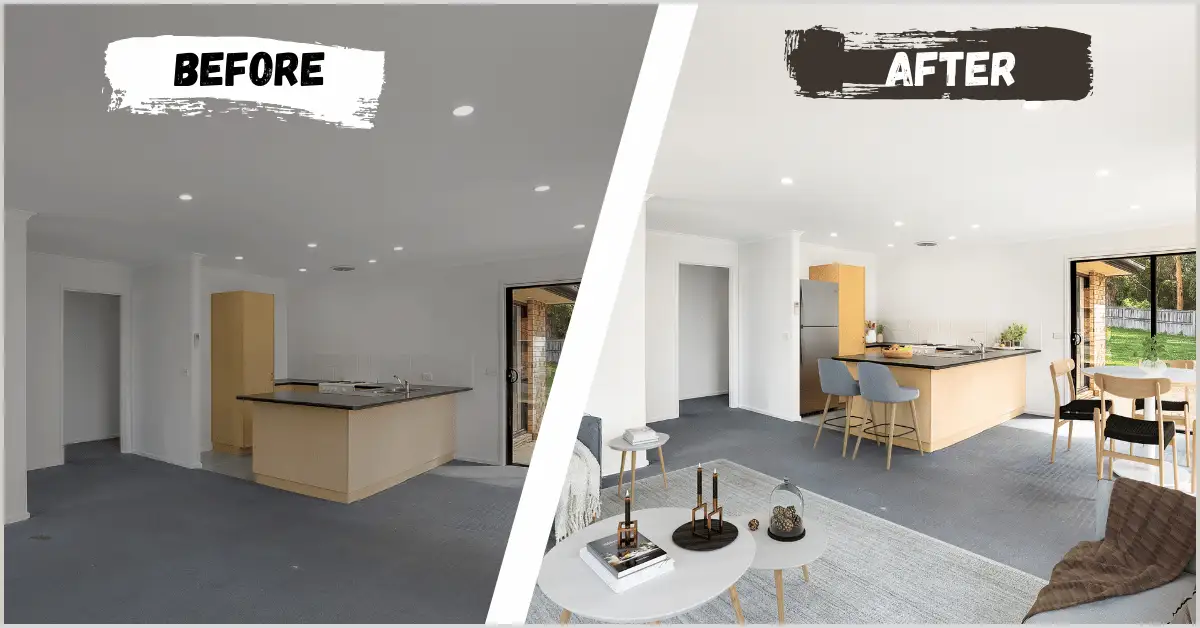
Greener Landscapes: Making lawns greener or flowers brighter is common. A human editor can do this carefully and naturally, avoiding colors that look too fake or cartoonish.
Trust and Honesty: Editors of your images will be the best source for making editorial decisions. An editor will know where the line is drawn between presenting an image as something that looks nice and that misleads someone into purchasing something; for example, they will not add things to a photo that do not exist or do anything to alter the proportions of an image deceptively, resulting in an honest presentation of a property, which trusts and is very valuable in real estate.
Client Interaction: When working with you, quality human editors will communicate directly with you to provide you with feedback and make customizations that will reflect your property exactly the way you envision it. Personal service like this is not currently available through AI photo editing.
AI Real Estate Photo Editing vs Human Editors: The Head-to-Head Comparison
The whole industry is trying to figure out if AI editing tools really produces better results compared to human edit time. What does this have to do with your question? A lot! All of us are interested to know, but no one has ever offered an honest assessment of whether AI editing tools promises faster corrections than human editors – until now.
According to numerous testers and photographers/editors, the speed at which AI real estate editing can process a large number of images is incredible. You can take 50 RAW images from an entire house shoot, and in just a few minutes, AI real estate photo editing will improve, straighten, and provide a base clean-up for those images.
The issue of quality is more nuanced. AI editing tools is usually accurate with the technical aspects of photography: precise white balance, perfectly straight lines, and bright blue skies that resemble a postcard; however, the human element brings emotion into photography.
Capture a challenging indoor image that contains a mix of two different types of light (bright sunlight coming through windows and warm light coming from inside lamps). Smart photo editors can do a great job at combining the two brightness results, but sometimes it overdoes it on wooden surfaces and gives them a plastic look.
Cost of services? AI real estate editing services can be much cheaper for larger groups of photos than human-based services (example- Pixelshouters). Still, when dealing with high-end properties and fine detail, it usually has a better outcome than the amount paid for the service.
AI Real Estate Photo Editing vs Human Editors: Pros, Cons and Key Differences
Time Required. An AI real estate editing program can edit a photo much faster than any human can, no matter how speedy or ‘quick’ they are.
Uniformity of Style. An AI real estate photo editing program is very uniform in that it adheres to the same style when processing all photos of the same subject matter.
Quality of Technical Detail. An AI real estate editing program is great at creating technical fixes, such as correcting colours and making sure lines are straight; however, sometimes the results of an AI real estate editing programme are too uniform and therefore do not have an artistic feel to them. Also, the AI editing tools does not understand how to produce feelings through the use of art. People have an incredible ability to add artistic effects and adjust photographs.
Problem-Solving: Great at solving problems it’s encountered before. If you present it with an unrecognizable or unusual problem in a picture, it may or may not be able to solve that problem. It just searches for pre-defined patterns and can only follow them. It does not use any of its own thoughts.
Human: A human editor is great at repairing unique problems that come up (for example, if there’s a weird reflection). They can fix the problem using creative methods as they encounter problems.
Creativity: AI real estate editing – limited to only the styles it has been exposed to, therefore cannot create anything original, nor does it feel the emotional quality of the space. Human unlimited because humans have their own unique style and therefore provide a complete set of artistic products; they know what is currently popular, as well as use their own feelings to create one-of-a-kind styles and edits/visuals for that purpose.
Expense: Generally, it will be a lot less expensive, typically only costing a penny or a few bucks per image. Human: It will cost more per image when working with a human because of all the time needed for skilled labor.
Ethics (Honesty): Acts automatically on commands without considering what would be ethical if it were a real estate listing (dishonesty).
Human Type: Uses its judgment based on the guidelines for showing homes accurately (professionalism) and will not create misleading information about the property.
Learning: learns through increased training data and improvements to its software. Human – learns through gaining experience, developing skills, and using feedback.
Good Things and Bad Things: The Real Deal
AI Real Estate Photo Editing: The Advantages
- Very Fast: Edits are completed, sometimes within the first few seconds or minutes of taking a photo. Perfect for real estate photos that have to be placed online immediately.
- Processes many photos: Able to process many photos without getting tired when working with them.
- Economically friendly: Many AI editing tools free or inexpensive trial products are available to test the product before spending any funds.
- Consistent look: All photos will have the same clean and refined look as they are part of the same photo collection.
- Useful for basic edits: Great for basic editing tasks such as object removal, sky replacement, or basic virtual staging.
- Fewer human errors: Computers do not become fatigued and do not make errors like humans do after performing similar digital manipulation for extended periods of time.
- Consistent availability: Functions 24/7/365 around the world.
AI Real Estate Photo Editing – What it won’t give you!
- Doesn’t give the human touch: Can create an unnatural or overly “ideal” look, can remove significant characteristics from an image or add things that may appear odd.
- Does not recognize the “story” behind each home.
- Generic results: Difficulties when it comes to lighting that is unique or very detailed buildings. These types of issues can cause things to look unnatural.
- Virtual furniture may be thought of as being “glued” or stuck to your screen (glued on).
- Lack of creativity: Will only replicate patterns that heretofore exist; will not create a brand new artistic concept.
- Can make mistakes: Will sometimes create odd-looking objects (blurriness or other artifacts), which I would have to manually correct due to the fact that the machine did not correctly identify the object.
- Lack of judgment: Will do any editing requested without determining if it’s ethical and/or morally correct.
Just like using a human for editing… All of the good parts.
In addition to personalization, Editors also focus on what makes your home different than other homes. They do this by capturing certain emotions and feelings about your home that would appeal to certain types of buyers. Creating custom edits that differentiate your home. Reputable for honesty and credibility in editing photos (trust). Attention to detail on quality of small materials: use of lighting, etc., with a warm and inviting feel.
Fixes Really Tough Problems: An editor can creatively address almost all types of uncommon and difficult editing problems.
One-On-One Contact: You can speak directly to the editor about what you are trying to achieve and get back exactly what you wanted.
Editing by Human Hand: The Stuff That Sucks
- Takes Longer – it takes forever to get done. It’s also going to take longer to upload the property into the system after the edit is completed.
- Costs More – because it’s hand edited and takes more time to complete each photo, the result for each property will cost more.
- Lots of Photos – if you have a lot of properties, it can be difficult and expensive to find only hand-edited photographs to use.
- Time constraints: Editors operate during set hours and may not provide an immediate response.
The two options available are different yet can both serve a purpose; neither will ever be considered the “better” solution, as your requirements, available resources, and financial considerations will dictate which option works best for you.
How Fast, How Much It Costs, and Scalability with AI Real Estate Photo Editing (The Smart Way to Decide)
In real estate, time is equal to money. The quicker or more efficiently you perform your tasks, the amount of money you will earn. The decision you must make when selecting between utilizing AI editing tools or a human to proofread will usually depend on one of the three items previously listed.
Quick Turn-Around: AI for property photos can process multiple photos in a matter of minutes. Smart photo editors can generate and publish a Real Estate Listing much faster than it used to, meaning they could sell quicker!
Human– Slower. It has taken an average professional photo editor (like me!) 3-10 hours; sometimes, I can do them in a day or two with enough time.
Price: AI-powered editing services: Generally lower than photo shooters. Typically charged based on the number of images that will be downloaded (e.g., at just $1–10 per image) or through monthly subscriptions.
Human: Usually higher than what you’d spend on an image being taken—you’re paying for experience (skilled work), time (valuable person), and know-how (creativity) via a picture being created—but could be a smart investment for high-valued properties.
Capacity For Maximizing Return On Investment (Scale Ability): AI-powered editing Can Handle An Infinite Number Of Pictures Regardless Of Whether It Is 10 Or 10000, And Can Do So, Efficiently!
HUMAN – Limited By Human Resources. For Every Additional Photo You Are Editing There Is Some Increased Cost And Increased Co-Ordination Effort For Each Additional Person Editing The Photo’s Its Harder To Make These Changes.
Choosing Wisely: AI real estate photo editing is typically the most effective and most economical way of managing basic properties (rental, inexpensive flips). AI-powered editing will typically be used to complete the first steps of a project for properties in the medium price range, but at some point, you may choose to employ human assistance in order to capture an important image.
When it comes to luxury homes, high-end properties, and unique properties, the investment of hiring an editor for your pictures is usually an expense well worth it. An experienced editor could make your pictures look better, allowing you to sell for a higher price and more quickly than if they were left unedited.
Being smart with the use of resources creates a successful real estate agent.
Quality Deep Dive: Realism, Honesty, and Connecting with Buyers (The Emotional Part of Photos)
Buyers need to connect emotionally with a home before deciding whether to purchase, thus, pictures alone do not provide the buyer with an emotional bond; therefore, the difference between AI real estate photo editing and Human Editing can be observed through what is technically perfect versus what is honest and provides all of the information that might connect a buyer with a property.
AI real estate photo editing’s “Perfect Look” vs. Human’s “Honest Feel”: Smart photo editors has a goal to make everything as ideal/perfect as possible, which can result in images being overly neat and sometimes too nice (emotionally) to be natural. Some smoothing out imperfections that naturally add character to homes may take away from the actual character of that house or home.
Humans: Understands that home is where life occurs. They can remedy some of the smaller imperfections due to having relatively large openings for natural light, which gives the house an unrefined and realistic experience compared to what they could do if they had artificial lights instead. An elderly indoor photographer might also soften the rough or harshness of certain shadows that create an inviting, warm atmosphere or allow for the visual representation of the actual texture of a piece of wood, such that it would be more real than the artificial nature of the photograph.
Building a Connection with Buyers: A kitchen with an AI real estate photo editing would likely have perfect clean counters, whereas a person may have left a slight shadow of a plant on their counter, and allowed for the unique texture of an old dining table; each of these touches adds to a buyer’s emotional attachment to a property, and research indicates that this may result in quicker offers.
Making Feelings: People are experts at making feelings. They can make rooms warm by changing the colour of the walls; they can draw attention to special features with concentrated light; and they can adjust the lighting very slightly to help create a room’s flow. Creating feelings is about telling a story instead of simply repainting pixels.
Relatability: When a photo feels honest, buyers can more easily imagine themselves living there. If a photo looks too perfect or fake, it can push buyers away.
Truth: Honesty is essential in real estate. To build trust, the owner of a home and the home itself must be represented as accurately as possible while maintaining the integrity of the improvements made to the property. Buyers want to experience what they see online at their home, as well as what they will discover when they view it live in person. Human editors will accurately represent the improvements made to the property and ensure that those representations are not misleading.
Real estate photography doesn’t only attempt to display an area; rather, it sells the dream of living there and what that would look like for you as an individual. AI real estate photo editing may create a perfect building based on technical measurements. Still, it is typically how the building is interpreted by the buyer through the interaction with the photographer that will create the real vision of a buyer’s ultimate living experience.
10 Simple Guidelines for Utilizing AI Real Estate Photo Editing and Knowing When to Call in an Actual Person
Here are ten simple tips on how to maximize your use of these tools:
- Start small by testing AI real estate photo editing free tools on a few of your unimportant listings before testing them with your photos to see how they work for you.
- Produce High-Quality Images: Use photo quality to maximize the effectiveness of AI real estate photo editing. Take clear photos with plenty of light and proper exposure. Smart photo editors will improve the quality of photographic images, but will not create great images from bad originals.
- Blend AI with Human Interaction: Use the initial editing done by AI real estate photo editing as your base for further editing by applying manual techniques. For the very best “hero” photography (that will be used for promotional purposes), start with your Smart photo editors edited photography and send it to your preferred human editor for review and finishing touches.
- Verify Every Time: Verify that you are not reliant upon AI real estate photo editing alone. Examine the Edited Images to determine if the new sky looks real; if there was an item deleted from the image that was of importance; & spend some time looking over your work – this last step will help to avoid an error occurrence.
- Priority the Major Rooms: Have humans create the edits for the living room, main bedroom & kitchen areas.
Only have AI real estate photo editing create the edits for the relatively unimportant rooms, such as hallways, bathrooms, etc. - Consider Who You Are Selling To: Human-Edited Content Adds Warmth to Family Homes, But Investors Prefer the Speed and Consistency of AI real estate photo editing for their Property Listing Page Content.
- Plan your Budget Carefully: If you can afford to do enough editing of your Luxury Home Property Listing Page, higher-end properties benefit from the quality of human editing more than any other property.
- Do Not Be Deceptive: Regardless of whether a human or an AI real estate photo editing program made the edits, do NOT deceive your buyers by including things that do not exist in the picture.
- Identify Popularity: Make a note of what edited images generate the most activity by tracking how many viewings or showings they get. This will allow you to make informed decisions about what types of AI real estate photo editing produce the greatest reaction from viewers.
- Stay Curious: New AI real estate photo editing tools are being released all the time. Make sure you look for them, and keep looking for new features in current tools that can help you!
By following these suggestions, you will be able to integrate the strong points from both people publishing and AI real estate photo editing, so your property can be published in the best way possible.
The Hybrid Approach: Why Both AI Real Estate Photo Editing and Human Editors Are Super Important Now
You can combine AI real estate photo editing and professional people to be even smarter than either one alone. Having the same number of boring/repetitive jobs done by The AI approach allows the human to use their creativity to produce great work. Companies such as Pixelshouters, which are very similar to yours, use The AI approach as a base, then utilize your creativity/skillset to create exciting, high-quality results quickly!
This combination gives you faster results, consistent quality, and that special spark. It’s not about replacing anyone – it’s about making the whole process better.
How They Work Together:
Consider the scenario of a photographer taking numerous pictures of a house. Instead of spending hours correcting brightness, straightening lines, and adjusting colors manually, they will upload the original images to an The AI approach solution and receive edited photos back within minutes. All of the final images produced from this process will be well-taken with all corrections made. Instead of spending time on those basic tasks, the photographer (or an experienced human editor) can now spend that same time on:
- Creating an Artistic Finish: Making one specific color stand out, softening bright areas of an image to pull in the viewer’s eye, or adding a unique “feeling” to an image!
- Tackling Tough Tasks: This can involve removing a troublesome reflection from inside a glass window, placing an authentic fireplace insert, or making corrections to an item that the The AI approach struggled with.
- Customized requests: For real estate agents, this involves making specific style adjustments in accordance with the agent’s ultimate marketing plan.
The collaboration between humans and AI real estate photo editing is a powerful combination, allowing editors to move beyond their massive number of repetitive tasks in order to focus on doing valuable, creative editing work that makes a listing distinctive. In this collaboration, the AI real estate photo editing will be a strong assistant to the human as they are the artist and director.
Looking Ahead: The Future of AI Real Estate Photo Editing (Always Changing Together)
Continual improvement of AI real estate photo editing through new capabilities, such as predicting consumer preferences and offering immersive virtual experiences. In addition, there will always be an editor present who enhances the experiment of turning a house into a home with thought-provoking narrative development/editorial expertise.
Who’s going to take home the prize? Those who incorporate both! Photographers combine AI real estate photo editing with their human support team (like the Pixelshouters) so they can do even more photographic jobs than ever before! And their listings will look amazing because both AI real estate photo editing free enhancements (as well as professional human edits) have been used together to create stunning, one-of-a-kind listings.
Latest Trends Ahead: With AI real estate photo editing Virtual Staging, the virtual staging rooms will appear completely furnished in various design styles (modern, warm & homely, etc.), giving the impression of the existing property being real.
AI for property photos Personalized Photos – The AI real estate photo editing will analyse the Photos to determine your individual taste to show you photos of the property that have been modified to fit your imaginary style preference.
Smart Photo Tips: AI for property photos could suggest which photos are best to use, or which angles work better, based on what has sold well in the past.
Wrapping It Up:
It is simply and honestly comparing AI real estate photo editing to that of a human editor. They are both very important. An The AI approach editor will allow for quicker turnaround time, making high-quality images easier to access than ever before. Still, nothing compares to the human editors who bring emotion, soul, passion, and creativity to the final product, making homes exquisite and hard to forget.
“Best” means different things to different people; therefore, there’s no real answer here except to summarize the key benefits of both tools individually. However, if you can find ways to use both AI real estate photo editing tools and a talent team, such as Pixelshouters, together efficiently, it will create a considerable competitive edge for your listings.