
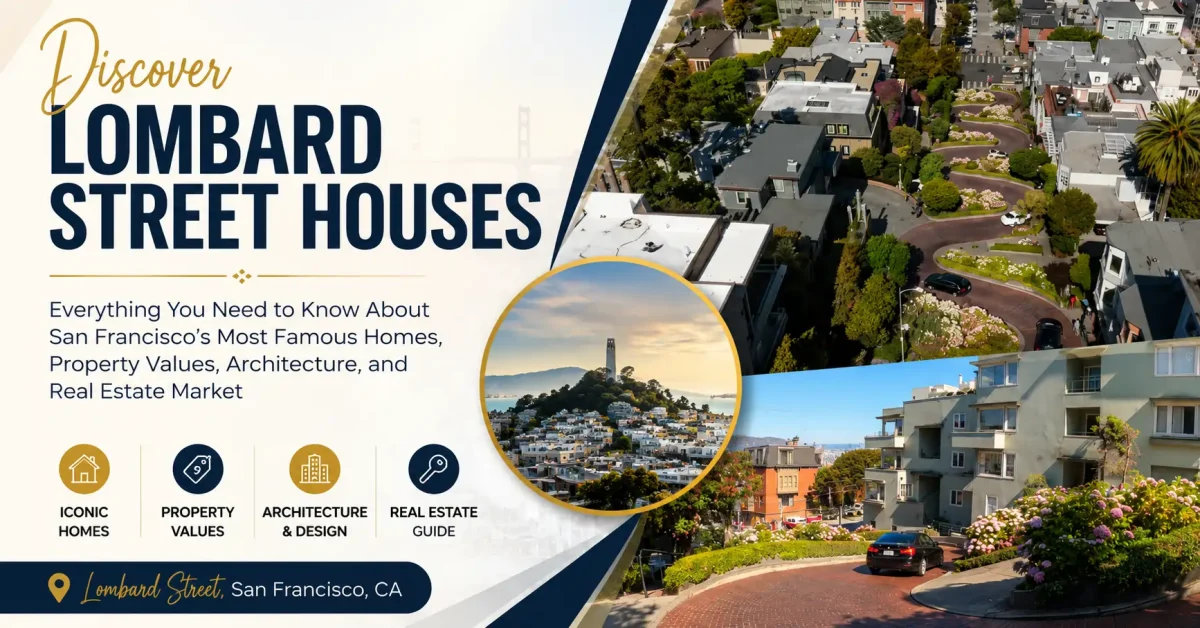
When people think of San Francisco around the world, they think of the Golden Gate Bridge, a cable car, and a steep red-brick street that winds its way between immaculate flower beds. That street is Lombard Street and the homes that line it are far more than scenery.
They’re working homes with mailboxes, garages, and families inside, but they happen to sit on a block that draws over two million visitors a year. The relationship between the crooked roadway and the surrounding Lombard Street houses is symbiotic— which is why professional real estate photography matters so much for landmark homes.
Table of Contents
What Makes Lombard Street Houses So Famous?
Engineering story: Before 1922, the block between Hyde and Leavenworth had a straight 27% grade, far too steep for vehicles and hazardous to pedestrians. It was proposed by local property owner Carl Henry to switch it back, and city engineer Clyde Healy designed it. Safety and access were intended, not tourism. The design worked so well that it actually saved property values that had been falling because cars could not reach the homes.
The visual transformation: Hydrangeas and other plantings were added in the 1960s. Red brick, green foliage, and pastel homes, it’s a color palette that photographs perfectly from every angle.
Global validation: Guinness World Records recognizes the 400-meter section for packing 1,440 degrees of turns into eight hairpin bends. Travel brands like Big Bus Tours describe it as the place to see “pretty red brick paving, manicured flower beds, and panoramic view of the bay.”
Media ubiquity: It comes in films, video games, and car adverts because the background immediately screams San Francisco. That then feeds into real estate prestige. Such exposure further parleys into home sales. When buyers search for “San Francisco iconic street house sale,” Lombard dominates the results. The houses are the frame for the photo. Without them, the street would be just an odd piece of pavement. Their consistent scale, bay windows, and carefully tended gardens all add to the effect.
A Brief History of Lombard Street in San Francisco
Russian Hill development. In the late 1800s, the development of Russian Hill created a streetcar suburb for merchants seeking views and breezes above downtown.
The problem of the hill. By 1920, cars were a thing, but the natural grade of the 1000 block was 27%. It was often the case that cars would stall, brakes would fail, and homeowners could not get to their property with any sense of certainty.
The 1922 solution: What Henry came up with, and the way Healy built it, created eight switchbacks that lowered the slope and allowed a 5 mph descent in one direction. It was done in 1922.
From local fix to world landmark: For decades, it stayed a neighborhood street. The addition of flowers in the 1960s, along with the rise of mass tourism in the 1980s and 1990s, transformed it. A city study in 2000 first quantified congestion, and a 2014 pilot closure tested what would happen if cars were banned for part of the day.
Preservation Today: There is no formal historic district, but groups like Lombard Hill Improvement Association and Russian Hill Improvement Association work with SFCTA and SFMTA to balance livability and tourism.
Where Are The Houses On Lombard Street Located?
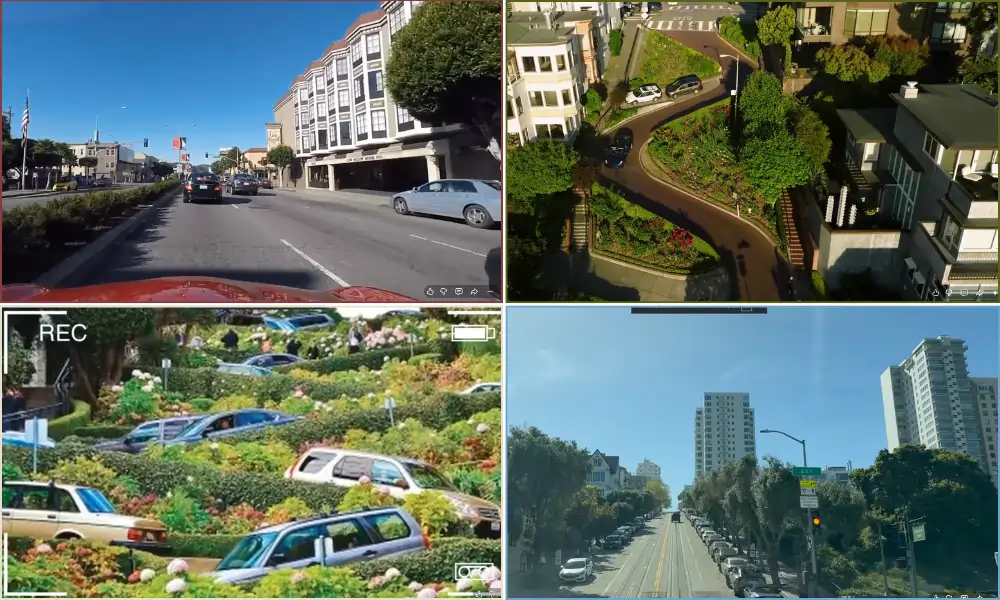
This is important because Lombard Street is 3 miles long, but only one of its blocks is crooked.
- The Crooked Block (1000 block, 94133). It’s between Hyde and Leavenworth in Russian Hill. This is where the famous houses sit right on the curves. Addresses here are extremely seldom available on the market.
- The Eastern Waterfront (94111). Condo buildings in the area include 101 Lombard, 150 Lombard, and 240 Lombard near the Embarcadero and Telegraph Hill. A flat walk to the living space is offered at these buildings, which share the Lombard name, but they all offer views of the bay.
- The Western Corridor (94123). From Van Ness to the Presidio, Lombard is a part of Highway 101. Here you’ll find Marina and Cow Hollow properties, including 1840-1842 Lombard, 1885 Lombard, and 2352-2356 Lombard. These are mixed-use, duplexes, and small apartment buildings.
Nearby attractions for all three zones include Fisherman’s Wharf, North Beach, Ghirardelli Square, and the Powell-Hyde cable car line, which stops at the top of the crooked block.
Lombard Street Map San Francisco
- Street layout: The curvy part is 180 meters long, one-way eastbound downhill.
- Natural gradient: 27%, and that’s why the switchbacks were necessary.
- Navigation: Cars line up on Hyde Street. Sidewalks have stairs on both sides. Big Bus Tours recommends coming on weekdays or early in the morning to avoid the crowds.
- Neighborhood context: To the south is Nob Hill, to the north is the waterfront, to the west is Cow Hollow. This central location is part of the value proposition.
The Different Types of Lombard Street Houses
Victorian Homes are mostly found on the flatter eastern end, in the vicinity of Telegraph Hill. These homes date to the 1890s-1900s and feature narrow 25-foot lots, ornate brackets, and tall double-hung windows. Many of them still have their interiors finished with Douglas fir flooring, detailed moldings, and formal parlors that have been opened up during modern renovations.
Edwardian Residences Built 1905-1915, mostly within the Marina. Take the one at 1840-1842 Lombard St: typical of the kind, it was constructed in 1912 as a 2,180 sqft duplex with a less elaborate front than the Victorians, larger garage openings added in the 1920s, and a private patio. The Edwardians are more popular with buyers looking for an old-style house with improved seismic resistance compared to the earlier Victorians.
Modern Luxury Homes. Overlooking the winding block, designers reconstructed. The best is 340 Lombard St, a 5,725 sqft, 5-bed, 6-bath creation by Jim Jennings Architecture, offered at $15,500,000. It has glass walls to the bay, roof decks, and underground garages that stay out of tourists’ way.
Historic Townhouses and Condos. Most of the searches for “homes for sale Lombard Street, San Francisco” probably end here. 150 Lombard and 240 Lombard are home to condos built in the 1990s, offering features such as doormen, gyms, and rooftop decks. A 1-bed at 240 Lombard #329 was sold for $498,000 in November 2025; a 2-bed at 150 Lombard #905 was sold for $1,365,500. These give the prestige of a Lombard address without the maintenance on the crooked block.
Architecture and Design Features
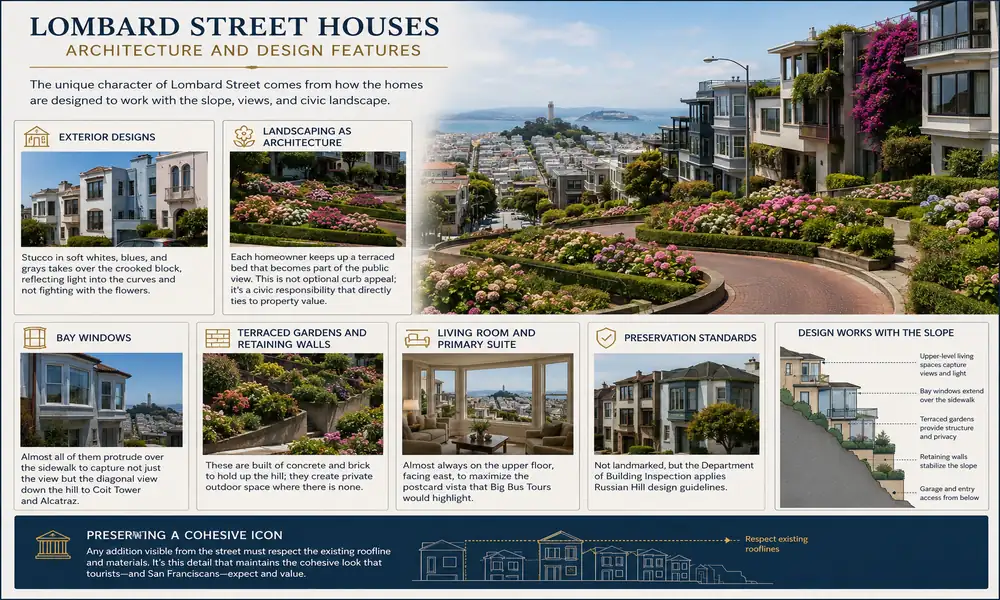
What really makes these houses look different is the way the design works with the slope.
- Exterior designs: Stucco in soft whites, blues, and grays takes over the crooked block, reflecting light into the curves and not fighting with the flowers.
- Landscaping as architecture: Each homeowner keeps up a terraced bed that becomes part of the public view. This is not optional curb appeal; it’s a civic responsibility that directly ties to property value.
- Bay windows: Almost all of them protrude over the sidewalk to capture not just the view but the diagonal view down the hill to Coit Tower and Alcatraz.
- Terraced gardens and retaining walls: These are built of concrete and brick to hold up the hill; they create private outdoor space where there is none.
- The living room and primary suite are almost always on the upper floor, facing east, to maximize the postcard vista that Big Bus Tours would highlight.
- Preservation standards: Not landmarked, but the Department of Building Inspection applies Russian Hill design guidelines. Any addition visible from the street must respect the existing roofline and materials; it’s this detail that maintains the cohesive look tourists expect.
Who Lives on Lombard Street?
The persistent question “who lives on Lombard Street” has a less glamorous answer than many expect. It is not movie stars but established San Franciscans.
The tax assessment records for 150 Lombard list family trusts and long-term owners. It is a roster that includes Laurence Zung, Van G Middlesworth Trust, the Bernadicou Family Trust, the Gouveia family, among others.
This shows a pattern reflecting properties across the hill, held for decades and passing through trusts. NeighborWho data for the broader Lombard corridor shows average property taxes at around $12.8K, with lot sizes ranging widely, and ownership dominated by LLCs and revocable trusts, the standard privacy play for high-visibility streets.
The resident profile breaks down as follows:
- Professionals in their 50s and 60s who purchased in the 1980s-1990s.
- Retirees are attracted to flat access at the top of the hill and walkability.
- Investors who own multi-unit buildings like 407-411 Lombard, a 9-unit building that generates $436,706 in gross annual income.
- Second homeowners use the property part-time, while long-term renters use it otherwise.
Privacy is a real concern, so interviews with residents are rare. Most homes are gated with cameras and have frosted lower windows.
What’s Living On Lombard Street Like?
Living here is a trade between prestige and patience.
Advantages:
- Iconic Location: You can walk to North Beach coffee in five minutes and be at the Ferry Building in fifteen.
- Property prestige: The address itself brings in buyers and renters.
- Scenic views: Even lower units look out over the bay as it winds its way below.
- Neighborhood atmosphere: It feels like a little village in Russian Hill, with all these corner markets (even if there is a bit too much tourism).
Challenges:
- Tourist traffic: The SFCTA study pegged the count at about 2 million a year, upwards of 17,000 per day on peak summer weekends. And the sidewalks feel more like a downtown than a residential neighborhood.
- Noise: The noise of brakes, tour guides, and photo shoots commences at 9 a.m. and continues until sunset.
- Parking: Parking is banned on the curvy block. Residents have small garages, which are crucial to their use; these were added in the 1920s and don’t fit modern SUVs.
- Maintenance: Vibration from constant traffic and foot traffic on stairs also wears out the foundations and landscaping.
The residents have adapted to the situation by using delivery lockers, scheduling their contractors for early mornings, and participating in the community meetings regarding management plans.
Lombard Street House Price: Understanding Property Values
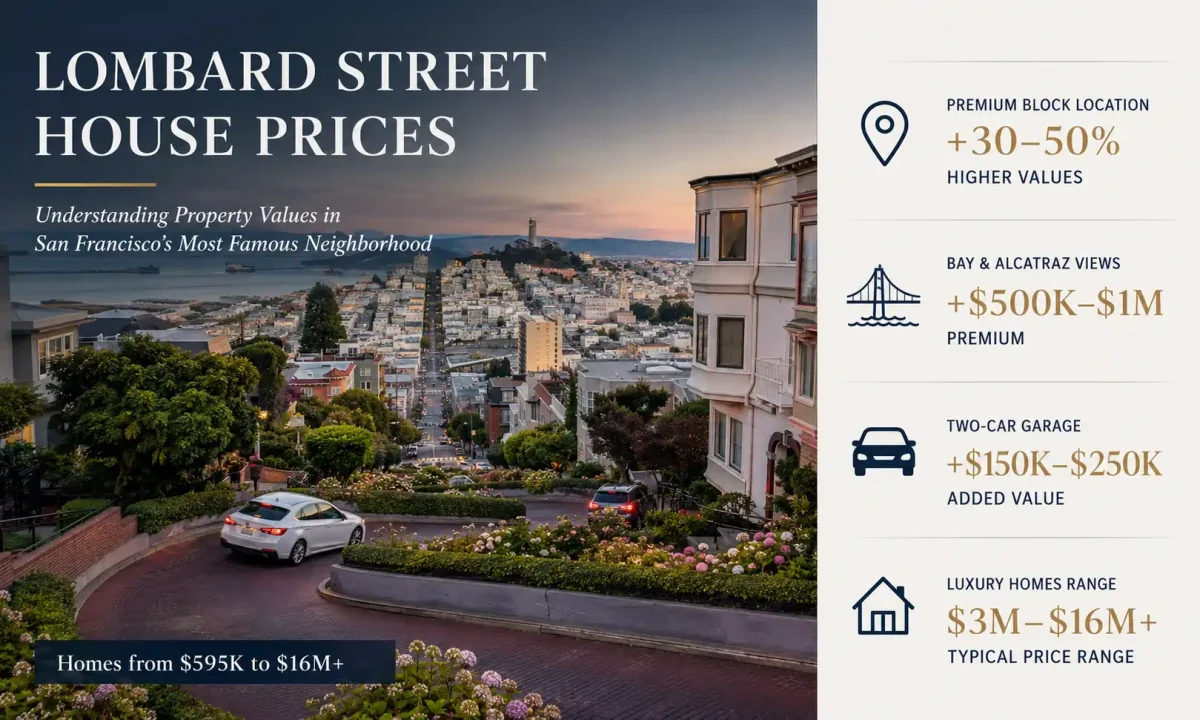
Factors Affecting Value
- Block location: A house on the 1000 block commands a premium of 30-50% over an identical house three blocks away.
- Views: Direct views of Alcatraz or the Bay Bridge add $500K to $1M.
- Parking: A two-car garage in Russian Hill brings $150K-$250K on its own.
- Historic integrity: Unaltered Edwardian facades are prized.
Premium Pricing Explained Current data points illustrate the spread:
- 333 Lombard St: Home of 3,000 square feet valued at $3,444,700
- 476 Lombard St: $2,076 per square foot
- 1028 Lombard St: Condo of 4 beds listed at $3,995,000
- 1275 Lombard St: Condo of 4,637 square feet listed at $4,954,000 in July 2025
- 101 Lombard #407W: Listed at $1,195,000
- 240 Lombard #727: Listed at $595,000
This range illustrates why “lombard street house price” is not a single number. It spans from starter condos to trophy homes.
Historical Value Trends: The 1922 remodel restored accessibility to the values. Since the 1970s, they’ve pretty much shadowed luxury trends in San Francisco, though with lower volatility because supply is capped. And even in downturns, that global fame acts as a floor of demand.
Homes for Sale Lombard Street San Francisco
Search “homes for sale Lombard Street, San Francisco,” and you’ll spot three patterns:
- Extreme scarcity on the crooked block. Sales here are often private.
- Steady condo turnover on lower Lombard. Buildings such as 101, 150, and 240 Lombard witness 5-10 sales each year.
- Mixed-use opportunities on Western Lombard. For example, this property at 2352-2356 Lombard for $1.95M has retail space on the ground floor and residential space on the floor above, which can attract owner-users.
Why listings are so infrequent: owners tend to hold on to their properties for decades, and the inconvenience of showings with tourists outside deters most casual sellers.
Houses for Sale on Lombard Street, San Francisco
For “houses for sale on Lombard Street, San Francisco” (read single-family), expect:
- Price ranges: From $3M to $6M, you can pick up a fixer Victorian that needs seismic work. Or, for $8M to $16M, you can grab a renovated view home.
- Competition: All-cash offers and offers with all contingencies removed are becoming increasingly common.
- Inspection considerations: Bring in a geotechnical engineer to assess hillside drainage, a structural engineer to review 1920s foundations, and a surveyor to confirm lot lines on terraced lots.
- Financing: Jumbo loans up to $3M are standard; above that, lenders require significant liquidity.
Lombard Street Homes for Sale: What Buyers Should Know
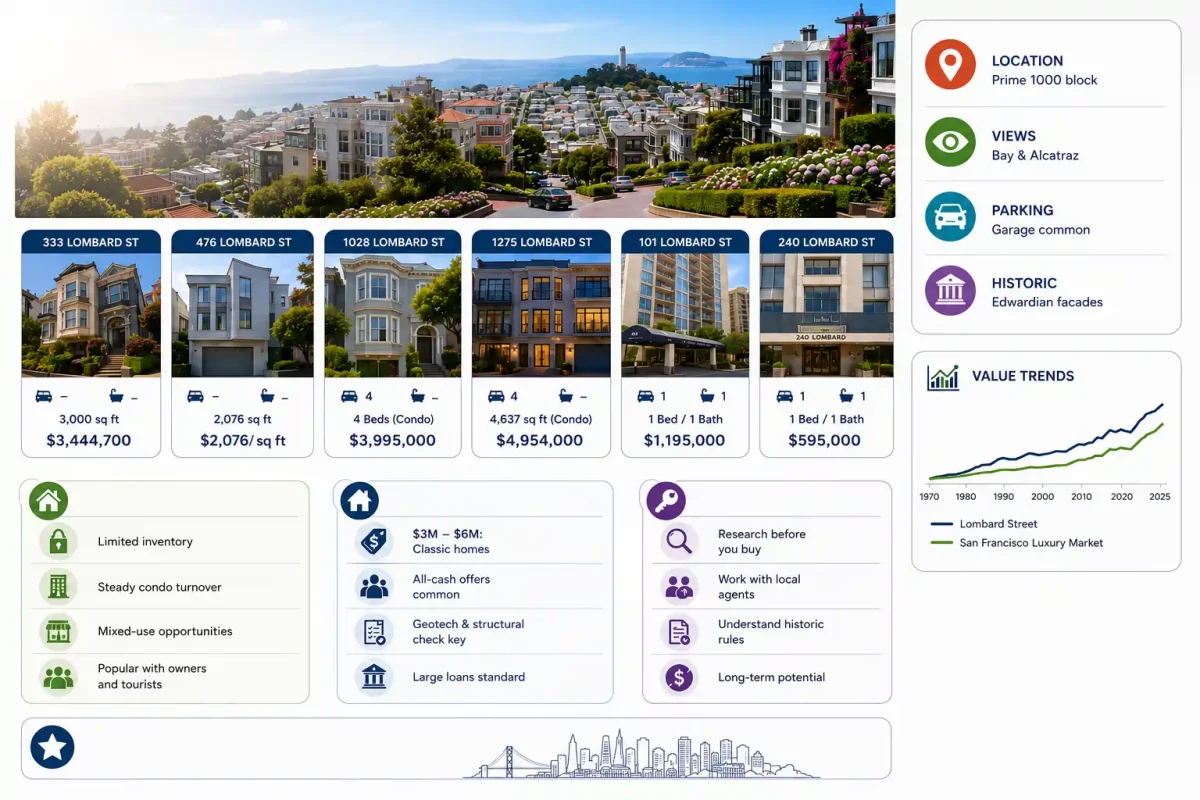
- Market Research: Do not rely on Zestimates alone. Walk the block at different times. The SFCTA found pedestrian spillover into adjacent roadways, which also affects noise on cross streets.
- Working With Local Agents: Work with an agent who has closed a deal in Russian Hill in the last 12 months. They will be aware of which buildings have special assessments for seawall work or hillside stabilization.
- Understanding Historic Property Rules: Even without landmark status, the Planning Department reviews exterior changes for compatibility. This protects your investment, but it does slow your renovation.
- Evaluating Investment Potential: Long-term rentals are strong. A 2-bed at 101 Lombard rents for $7,890/month. Short-term rentals are prohibited for non-primary residences, so do not underwrite Airbnb income.
Buying Process Explained
- Property search: Set alerts for “Lombard Street homes for sale” and “Lombard Street houses for sale” and filter by zip codes 94133, 94111, 94123.
- Neighborhood evaluation: Visit on a Saturday at 2 p.m. If you can tolerate the crowds, then you will love it the rest of the week.
- Financing: Obtain fully underwritten pre-approval. Sellers prefer certainty over the price.
- Due diligence: Look at the SFCTA Lombard Study and any pending legislation on access fees. A future reservation system could alter traffic patterns.
- Closing process: It may be a standard 17-day inspection or a 21-day loan contingency in California, but expect pressure to shorten the timeline.
- Post-purchase: Say hello to the Lombard Hill Improvement Association. They coordinate the gardening days and security updates.
Are Lombard Street Houses Smart Investments?
- Appreciation potential: Yes, because the supply of real estate in Lombard is fixed while demand is coming from all over the world. The fame of the street is continuous marketing in itself.
- Rental opportunities: Multi-units do well. The 9-unit at 407-411 Lombard is a good example of how classic San Francisco charm and views can yield $436K in gross income.
- Luxury market performance: In downturns, trophy properties hold value better than generic condos.
- Risks: The 2019 proposal to charge $5 on weekdays and $10 on weekends and to limit the number of vehicles to 4,800 per day was never implemented but remains under discussion. If it passes, it could lessen noise (a good thing) and also alter the “free to drive” allure. Keep an eye on the SFMTA agendas.
- Long-term ownership advantages: Pride of ownership, strong resale story, and potential Mills Act tax savings for qualifying historic homes.
The SFCTA’s final report frames the core conflict: livability and tourism are continually juxtaposed on a residential block that is also an attraction. Residents report: visitors blocking driveways for photos, trash in garden beds, and ride-share drop-offs in the middle of the curves.
The city’s recommended strategies include enhanced enforcement, industry partnerships, engineering enhancements, and a reservations and pricing system. As of 2026, the street is still free, but the talk continues because peak days bring pedestrian traffic at all corners of Lombard/Hyde and Lombard/Leavenworth. For owners, adaptation strategies include installing retractable bollards, smart doorbells, and weekly gardeners to repair tourist damage quickly.
Comparing Lombard Street Houses to Other Luxury San Francisco Neighborhoods
- Pacific Heights: Bigger lots, less noise, about the same price per square foot, but fewer tourists. Lombard wins in fame—
- Nob Hill: More tall condos, about the same walkability, lower price to get in. Lombard wins on land.
- Russian Hill (non-Lombard): Same zip code, 10-15% lower price, no crooked-block bonus.
- Marina District: Flatter, younger people, more shopping. Lombard wins in history.
For investors, Lombard offers a special smallness bonus that Pacific Heights can’t copy.
Common Myths About Lombard Street Houses
- Myth: Every house is worth millions solely because of location. Reality: A 1-bed condo at 240 Lombard sold for $498,000. Location helps, but size and condition matter.
- Myth: Nobody actually lives there. Reality: Tax rolls show hundreds of individual owners and family trusts who have lived there for decades.
- Myth: Properties are always available. Reality: The crooked block may go years without a public listing.
- Myth: Tourism makes living impossible. Reality: The SFCTA study shows challenges, but also that residents prioritize maintaining access and preserving tourism, indicating a balance is possible.
Future Outlook for Lombard Street Real Estate
- Market trends: San Francisco’s luxury market in 2025-2026 favors unique, low-maintenance properties. Lombard condos fit this profile.
- Preservation efforts: Community groups oppose widening or straightening to preserve the character.
- Buyer demand: Post-pandemic, international buyers are returning and searching for “San FranciscoSan Francisco iconic street house sale,” with Lombard leading the list.
- Neighborhood development: There can be no major new construction on the hill to protect its scarcity.
- Long-term property outlook: If a reservation system is implemented, livability may improve, boosting resident values while preserving the street’s draw.
Frequently Asked Questions
- Who resides on Lombard Street?
Long-term owners, professionals, and investors, mostly via trusts for Privacy. - What’s the price of a house on Lombard Street?
$500K-$1.2M for condos, $1.5M-$5M for flats, $3M-$15.5M for single-family homes. - Homes for sale on Lombard Street in San Francisco right now?
Yes, primarily condos at 101, 150, 240 Lombard, and mixed-use buildings on western Lombard. - Is Lombard Street a good place to live?
Sure, if you like walking around and seeing iconic views and don’t mind big crowds, that is. - What makes Lombard Street famous?
It was constructed in 1922, with eight hairpin turns to control a 27% grade, and then later made beautiful with flowers. - Can tourists visit at any time of the year?
Yes, 24 hours a day and 7 days a week, and free. - How frequently do Lombard Street houses come on the market?
Rarely for crooked-block homes, and quite regularly for corridor condos. - What types of homes can be found?
Victorian, Edwardian, modern luxury renovations, and 1990s condos. - Is parking difficult?
Yes, garages are small, and street parking is limited.
Conclusion
Lombard Street houses are much more than mere real estate. They are living landmarks where engineering necessity brought beauty into being and beauty later brought forth global fame. From the 1922 decision to add eight curves for safety to the market today, where a condo can start under $600K, and a trophy home can exceed $15M, the street offers a full spectrum of San Francisco living.
The key to Lombard Street houses is to see both sides: the postcard and the plumbing, the tourists and the trusts, the premium pricing and the daily patience required. For buyers who value rarity, walkability, and a story no other address can tell, Lombard remains one of the most fascinating residential opportunities in the world.