
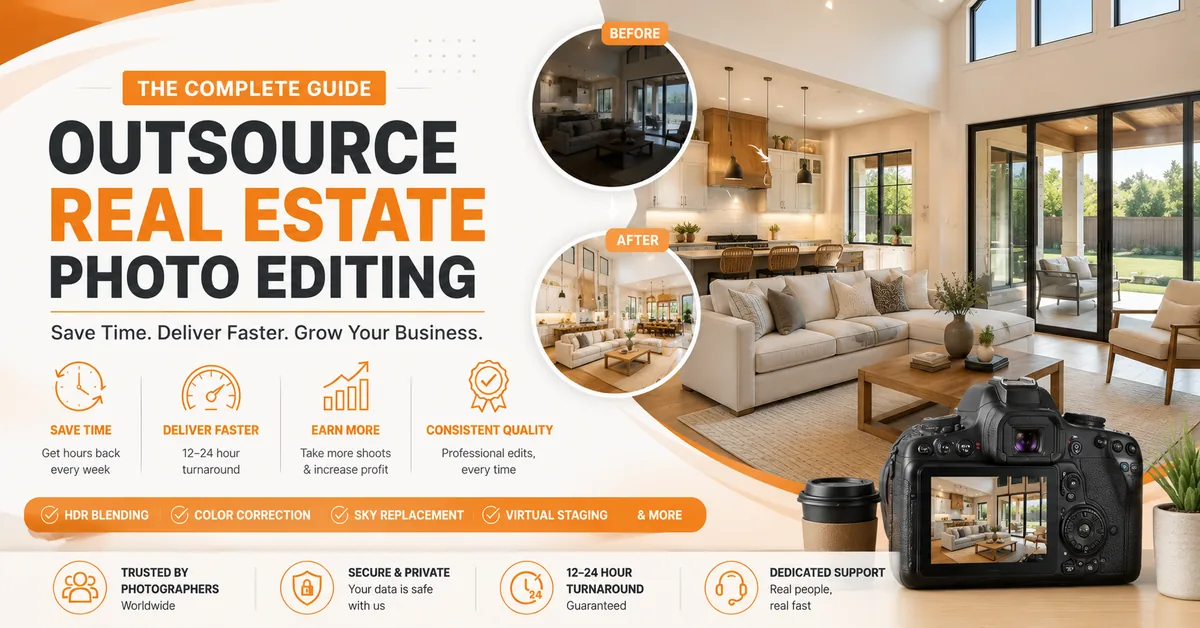
Quick answer: outsourcing works best when editing is taking time away from shooting, client communication, and delivery. This checklist explains what to send, what to test, how to compare editors, and when to scale. If you want a done-for-you editing team instead of a checklist, start with PixelShouters’ real estate photo editing outsourcing workflow.
Table of contents
- What outsourcing real estate photo editing means
- Why photographers outsource editing
- Services you can outsource
- Who should outsource
- How to choose an editing company
- How to test before scaling
- 2026 cost breakdown
- FAQ
Introduction
It’s 9:47 pm. You just shot a 4,200-sq-ft listing, a condo, and a rental. Your SD cards hold 612 frames. Your agent texts: “Can we have these by 8am for MLS?” You know what that means — cull, HDR merge, fix the blown windows, pull the green out of the kitchen LEDs, replace that gray sky, export three sizes, rename, upload. Again.
➡️ This is exactly where outsourcing real estate photo editing services becomes essential for modern photographers.
This is the invisible second shift of real estate photography. Most photographers didn’t start their business to become full-time retouchers.
That’s why more shooters now outsource real estate photo editing. Not because they can’t edit, but because editing is the bottleneck. When you hand it off, you get your evenings back, your delivery speeds up, and your calendar can actually grow without you burning out.
This guide breaks down every piece — what outsourcing really looks like day-to-day, which services make sense to hand off, how to avoid the horror stories, and what a good partner costs in 2026.
What Does It Mean to Outsource Real Estate Photo Editing?
Think of it as hiring a night shift you never have to manage.
You shoot like normal. Back at your car, you cull the keepers in Photo Mechanic or Lightroom — maybe 35 images from a house. You upload the RAW brackets to a shared folder. You drop in a one-page style note: “Bright but not HDR-ish, windows visible, warm 5600K, grass natural, sky only if flat gray.”
By the time you wake up, a team (often in the Philippines, Vietnam, or India due to time zones) has:
- Merged your brackets
- Corrected verticals
- Balanced color
- Pulled the windows
- Cleaned cords and trash cans
- Exported MLS-size JPEGs with your file naming
You download, do a quick QC pass, and send to the agent. Total hands-on time for you: 15 minutes.
Who actually uses outsourced real estate photo editing services?
- Solo photographers in Dallas are doing 18 homes a week in the spring
- Husband-wife teams where one shoots video and the other uses it to edit until 1am
- Boutique media companies offering photo, video, drone, and floor plans — they can’t hire three editors.
- Large brokerages with an in-house shooter who needs backup during inventory spikes
Freelancer vs Company
A freelancer on Upwork might charge $2 per image for normal editing and $5 for complex work, and you text them directly. Great for control, bad when they go on vacation. A company gives you a portal, a QC manager, and 10 editors on rotation. You lose the personal chat, but you gain coverage when you suddenly send 400 images on a Monday.
Why More Photographers Are Outsourcing Their Photo Editing
It’s not just about being tired. The numbers force the decision.
Buyers decide online first. 97% of home buyers use the web, and high-quality photos drive clicks. Another 2026 review found 83% of buyers prioritize high-quality images when choosing listings to visit.
Good editing pays: listings with professional processing sell 32% faster, fetch $3,000–$11,000 more, and get 61–118% more views.
Business Impact of Outsourcing Real Estate Photo Editing
For photographers, the math flips when you outsource:
- Teams report handling 40% more projects per month because real estate photo editing turnaround can shrink to 12–24 hours when the upload, QC, and delivery workflow are planned correctly.
- One case study showed a photographer saving 15 hours per month, which turned into 2–4x ROI when that time went to shooting.
- Offshore outsourcing can reduce costs by up to 60% compared to local hires, and cuts effective editing costs by $240+ per hour of your time
- Large providers process over 3,000 images daily with 12-hour turnarounds, meaning your 30-image house is trivial.
Real-World Benefits
- Time savings: Maria in Phoenix stopped editing at midnight. She now uploads at 6pm, delivers at 7am, and uses evenings for client calls.
- Faster delivery: Agents get galleries before their morning coffee, which means more referrals.
- More bookings: When editing isn’t the limit, you can take that Friday rush job.
- Business growth: You spend time on pricing and marketing, not sliders.
- Work-life balance: Weekends off become possible again.
- Consistent style: A trained team follows your guide better than you do when exhausted.
Common Real Estate Photo Editing Services You Can Outsource
HDR Blending
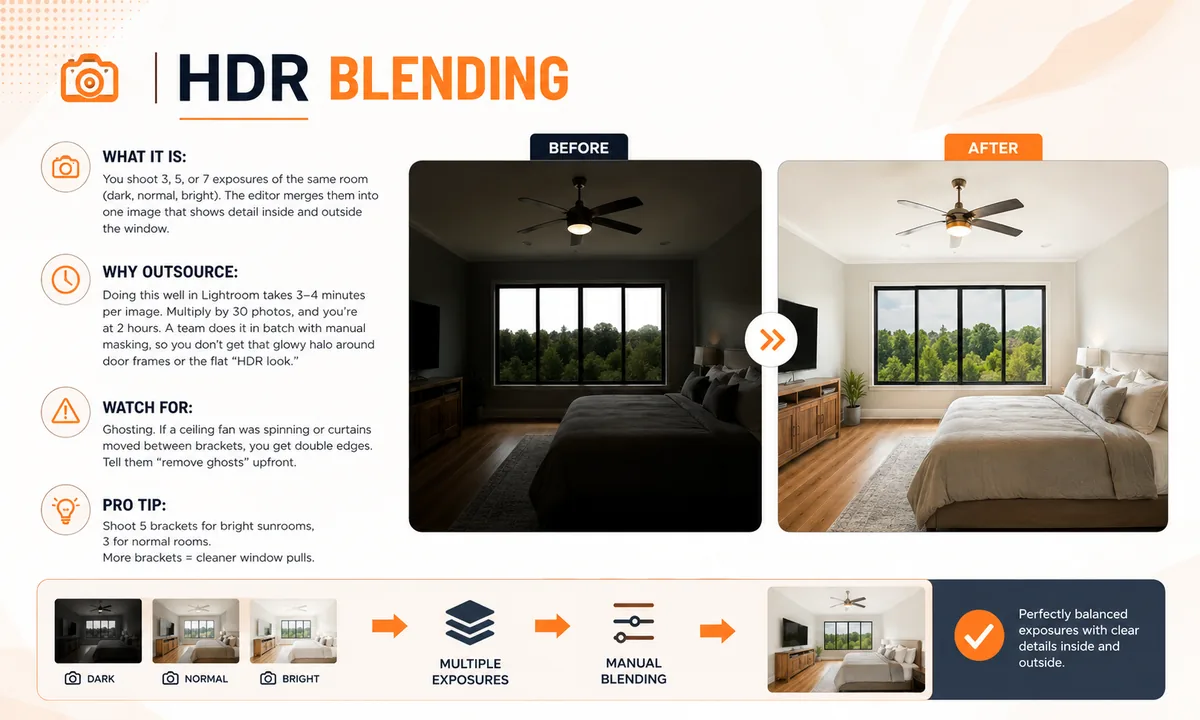
What it is: You shoot 3, 5, or 7 exposures of the same room (dark, normal, bright). The editor merges them into one image that shows detail inside and outside the window.
Why outsource: Doing this well in Lightroom takes 3–4 minutes per image. Multiply by 30 photos, and you’re at 2 hours. A team does it in batch with manual masking, so you don’t get that glowy halo around door frames or the flat “HDR look.”
Watch for: Ghosting. If a ceiling fan was spinning or curtains moved between brackets, you get double edges. Tell them “remove ghosts” upfront.
Pro tip: shoot 5 brackets for bright sunrooms, 3 for normal rooms. More brackets = cleaner window pulls.
Exposure Correction
What it is: Fixing a single shot (or flambient base) that’s too dark in the corners or blown on the lampshade.
Why outsource: Lifting shadows creates noise. A good editor uses local adjustments and noise reduction, not just the global exposure slider. They’ll recover white cabinets without turning them gray.
Watch for: Over-brightening. MLS photos should feel bright, not nuclear. Give them a reference: “I like +0.3 EV, not +1.0.”
Color Correction
What it is: This is the make-or-break skill. Real homes have warm bulbs, cool windows, and greenish LEDs all in one shot. The editor neutralizes each light source so the walls look white, not yellow.
Why outsource: Most DIY edits fail here. You set the white balance to 5500K, and the whole room goes blue. Pros mask the window light separately from the tungsten lamps.
Watch for: Specify your target. Many U.S. photographers ask for 5400–5600K for that “bright but warm” look. In Europe, 5200K is more common. Send one finished photo as your anchor.
Window Pulls / Window Masking
What it is: The editor takes your darkest bracket (where you can see the trees outside), cuts out just the window, and blends it into the bright interior shot.
Why outsource: It’s tedious masking work. Done poorly, it looks like a sticker slapped on. Done well, buyers can see the view, which agents love.
Watch for: In sunny markets like Arizona or Florida, this is non-negotiable. Ask for “natural window brightness,” not “HDR windows.”
Sky Replacement
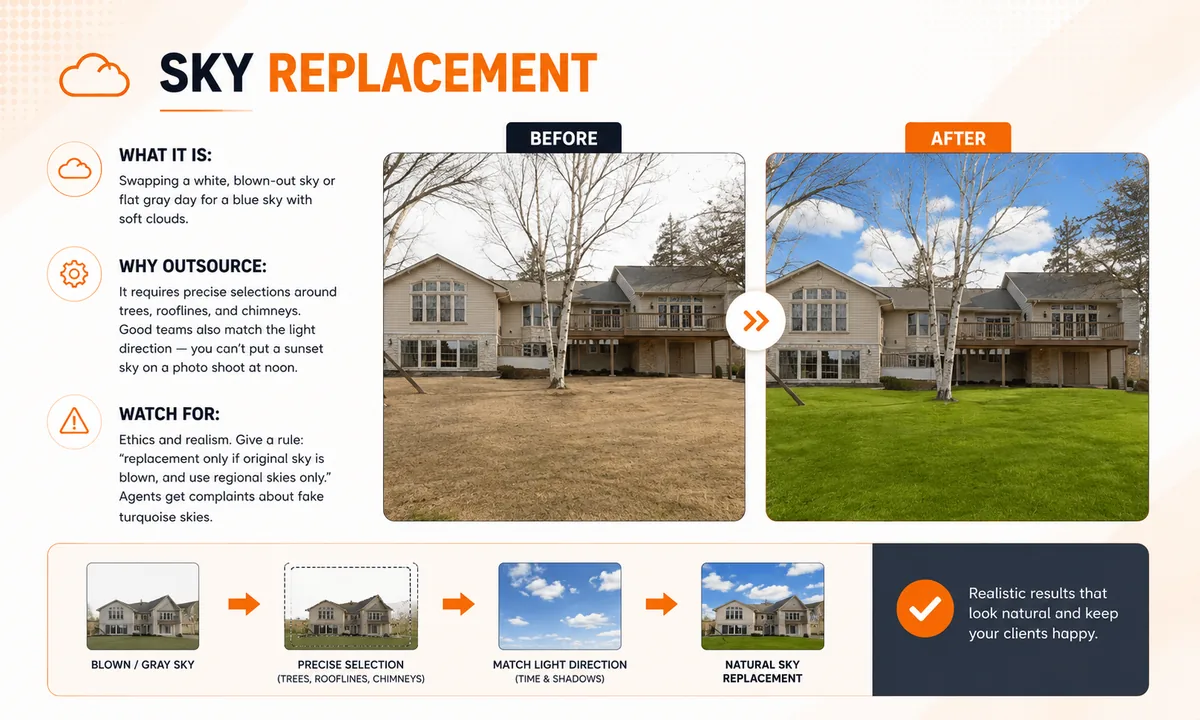
What it is: Swapping a white, blown-out sky or flat gray day for a blue sky with soft clouds.
Why outsource: It requires precise selections around trees, rooflines, and chimneys. Good teams also match the light direction — you can’t put a sunset sky on a photo shoot at noon.
Watch for: Ethics and realism. Give a rule: “replacement only if original sky is blown, and use regional skies only.” Agents get complaints about fake turquoise skies.
Lawn Enhancement
What it is: Selectively boosting green, fixing brown patches, and toning down yellow spots — without making it look painted.
Why outsource: It’s 5–7 minutes of careful masking per exterior. A team does it faster and keeps the texture.
Watch for: The Astroturf problem. Tell them, “enhance, don’t replace.” Keep some variation so it still looks like real grass.
Object Removal
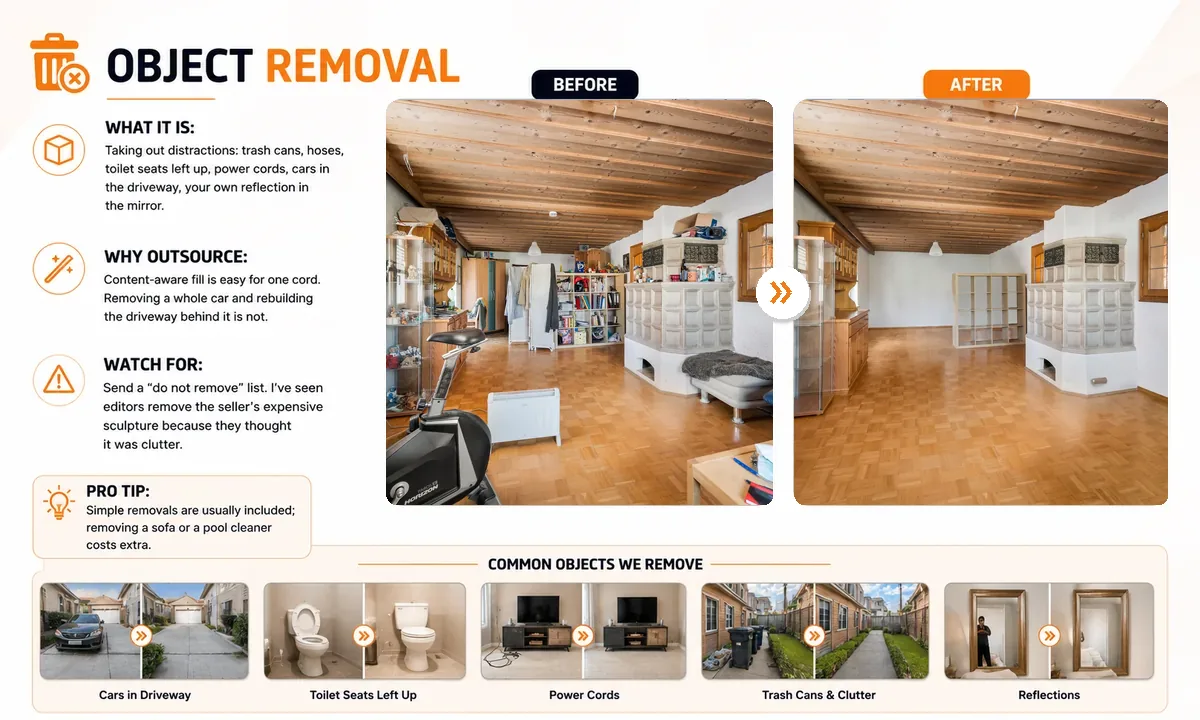
What it is: Taking out distractions: trash cans, hoses, toilet seats left up, power cords, cars in the driveway, your own reflection in the mirror.
Why outsource: Content-aware fill is easy for one cord. Removing a whole car and rebuilding the driveway behind it is not.
Watch for: Send a “do not remove” list. I’ve seen editors remove the seller’s expensive sculpture because they thought it was clutter. Simple removals are usually included; removing a sofa or a pool cleaner costs extra.
TV Screen Replacement
What it is: That black rectangle becomes a neutral piece of art, a fireplace, or a lifestyle image.
Why outsource: It needs perspective warp and a slight reflection to look real. Takes 2 minutes for a pro, 10 minutes if you’re learning.
Watch for: Keep it MLS-safe. No logos, no fake sports games. Most photographers use the same 3–4 neutral images.
What it is: Empty room + 3D furniture = furnished photo. You pick the style.
Why outsource: This is a separate skill from photo editing. It’s 3D rendering, shadows, and scale matching.
Watch for: It’s not in your $1 per image package. Expect $15–$35 per image and a 24–48 hour turnaround. Always label it “virtually staged” for MLS compliance.
Day to Dusk Conversion
What it is: Turning a daytime exterior into a twilight shot. Sky goes dark blue, interior lights are warmed up, and landscape lights are painted in.
Why outsource: It’s color grading and masking, not just a filter. Works best if you shot the house in soft overcast light — harsh noon shadows don’t convert well.
Watch for: Ask for a sample first. Bad dusk conversions look like a blue filter was dumped on the house.
Floor Plan Redraw
What it is: You send a hand-drawn sketch, iPhone scan, or Matterport export. They return a clean, branded 2D floor plan with measurements.
Why outsource: It’s CAD work, not photography. Most teams deliver in 24 hours.
Watch for: Provide accurate measurements. “Approximate” plans create liability.
Virtual Renovation
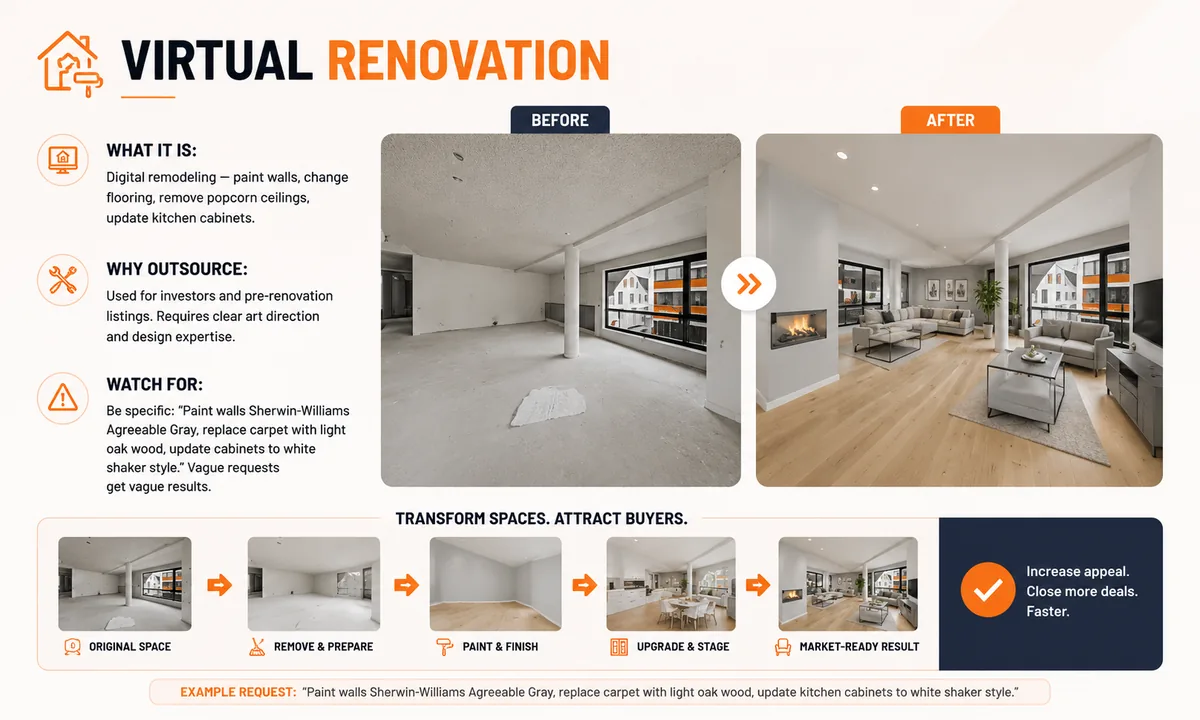
What it is: Digital remodeling — paint walls, change flooring, remove popcorn ceilings, update kitchen cabinets.
Why outsource: Used for investors and pre-renovation listings. Requires clear art direction.
Watch for: Be specific: “Paint walls Sherwin-Williams Agreeable Gray, replace carpet with light oak wood.” Vague requests get vague results.
Drone Photo Editing
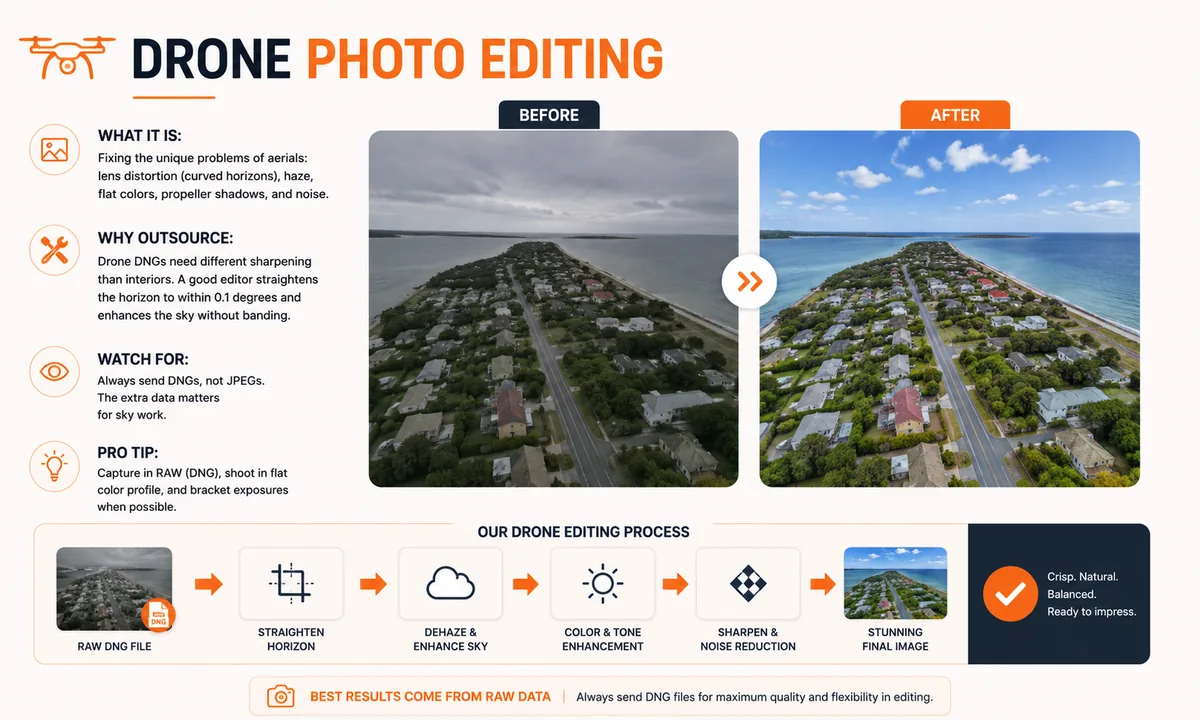
What it is: Fixing the unique problems of aerials: lens distortion (curved horizons), haze, flat colors, propeller shadows, and noise.
Why outsource: Drone DNGs need different sharpening than interiors. A good editor straightens the horizon to within 0.1 degrees and enhances the sky without banding.
Watch for: Always send DNGs, not JPEGs. The extra data matters for sky work.
Twilight Enhancement
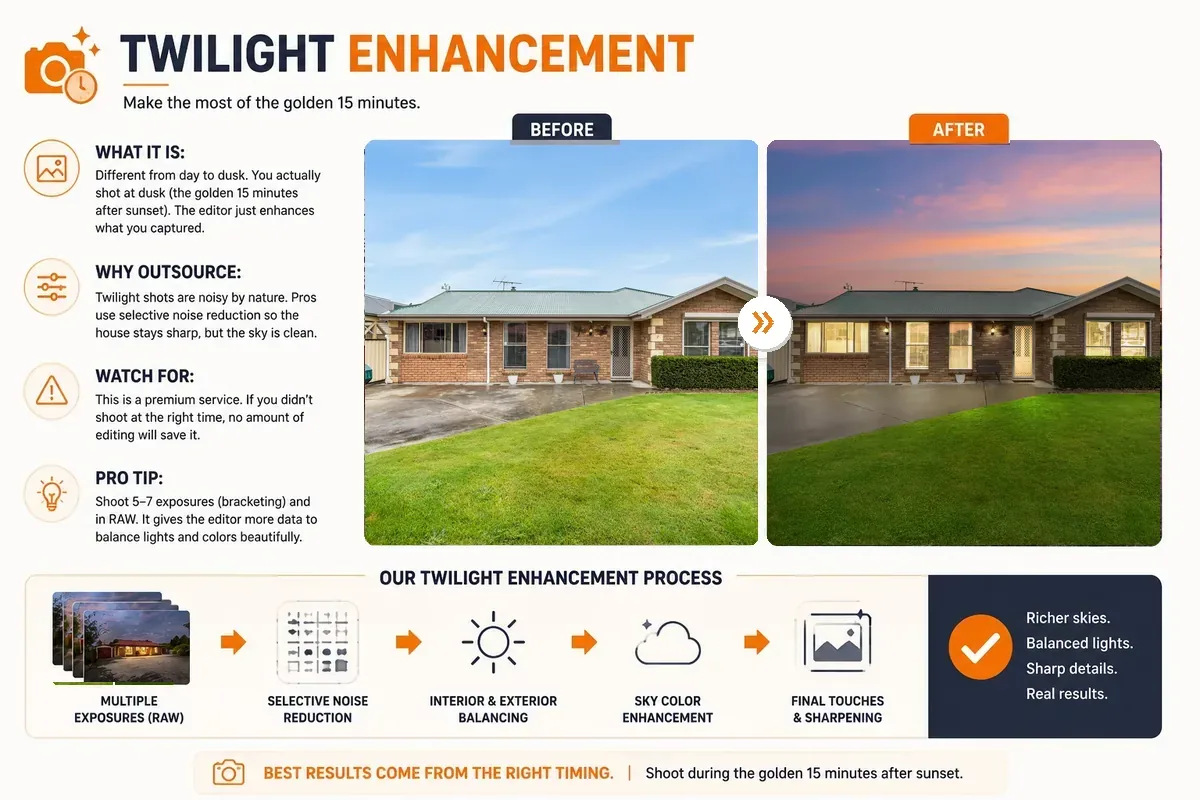
What it is: Different from day to dusk. You actually shot at dusk (the golden 15 minutes after sunset). The editor just enhances what you captured — balances interior glow, cleans noise, boosts sky color.
Why outsource: Twilight shots are noisy by nature. Pros use selective noise reduction so the house stays sharp, but the sky is clean.
Watch for: This is a premium service. If you didn’t shoot at the right time, no amount of editing will save it.
How to Use This Menu in Real Life
Most photographers start with a “core pack”: HDR blending + color correction + window pulls + vertical correction. That’s your $0.80–$1.50 per image baseline.
Then you add à la carte for the hero shots: sky replacement on the front exterior, lawn enhancement, object removal for the kitchen island cord.
You only pay for virtual staging, day-to-dusk, or renovation when the agent specifically orders (and pays for) it.
When you brief a new editing partner, don’t say “edit these.” Say:
“Core pack on all interiors, sky + lawn on images 01 and 02, remove trash can in 07.”
That’s how you get consistent pricing and avoid surprise invoices.
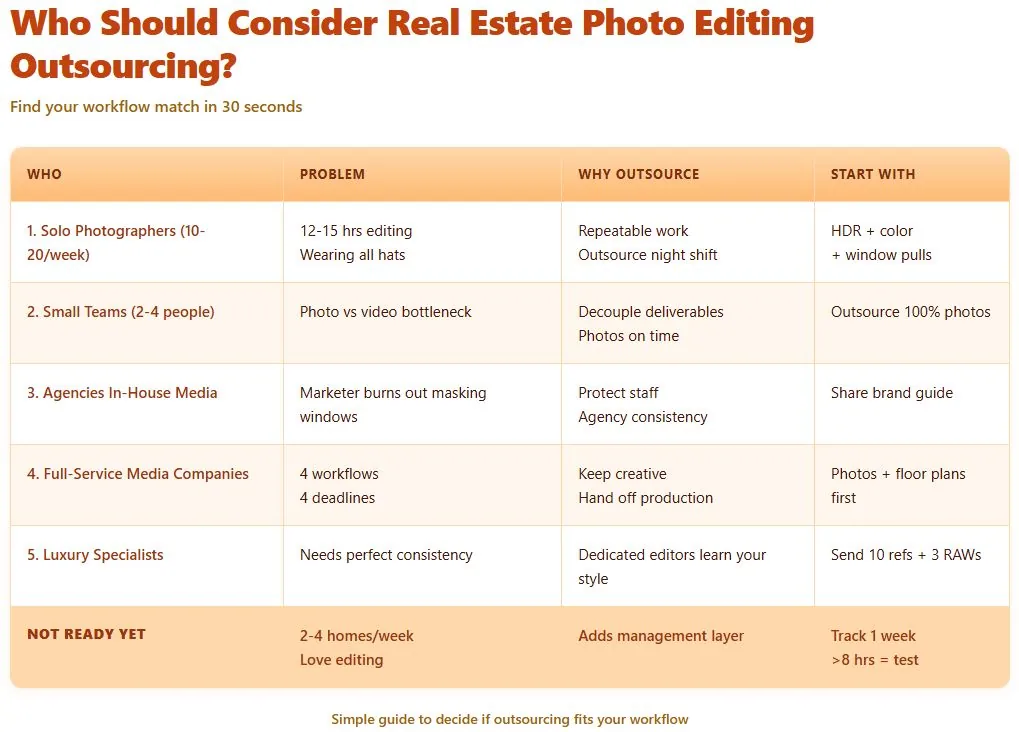
Who Should Outsource Real Estate Photo Editing?
1. Solo Photographers Doing 10–20 Shoots a Week
You’re not just the photographer. You’re the culler, the HDR merger, the Dropbox uploader, the invoice sender, and the person answering “are they ready yet?” at 10pm.
At 10 homes a week, you’re looking at roughly 250–300 final images. Even if you’re fast (3 minutes per image), that’s 12–15 hours of pure editing. That’s a full day and a half you aren’t shooting, marketing, or sleeping.
Why outsourcing fits
Editing is the most repeatable part of your job. You can write a style guide once — “5500K, windows pulled, verticals straight” — and a team will do it the same every time. You can’t outsource shooting, but you can outsource the night shift.
Real example: Jake in Tampa was shooting 14 homes in the spring. He was editing until 1am, delivering late, and agents started booking his competitor. He tested outsourcing just the HDR blends ($1.10/image). He got 3 hours back per day and used it to take 3 more shoots that week. The editing cost paid for itself in one extra booking.
Start with: Basic HDR + color + window pulls. Keep final QC yourself for the first month.
2. Small Teams (2–4 People)
This is the classic trap: one person shoots photos, the other shoots video. Then you both come home and fight over who has to edit photos tonight because the video takes longer.
Photos pile up while you’re rendering a 4-minute walkthrough. Agents don’t care about your workflow — they want photos at 8am and video at 5pm.
Why outsourcing fits
It decouples your deliverables. Your video editor can stay in Premiere, and photos still go out on time. You stop being the bottleneck for your own teammate.
Real example: A husband-wife team in Denver. She shot, and he edited the video. Photos were always 24 hours late. They outsourced photo editing to a team in the Philippines with a 12-hour turnaround. Now she uploads at 6pm, photos are back at 6am, and he never touches Lightroom.
Start with: Outsource 100% of photos, keep video in-house. It’s easier to train a photo style than a video style.
3. Real Estate Agencies with In-House Media
Your marketing coordinator is great with a camera, but they were hired to run Instagram and open houses, not spend Tuesday night masking windows.
When they edit late, two things happen: the work gets sloppy, and they burn out and quit.
Why outsourcing fits
You protect your staff’s daytime hours, and you get agency-level consistency. An external team doesn’t call in sick during listing season.
Start with: Give the editing team your brand guide (logo placement, export sizes, file naming for your CRM). Treat them like a silent employee.
4. Full-Service Media Companies (Photo + Video + Drone + Floor Plans)
You’re selling packages, not just photos. That means four different editing workflows, four software subscriptions, and four chances to miss a deadline.
You cannot be excellent at all of them in-house unless you hire 3 editors, which kills your margin.
Why outsourcing fits
You keep the high-margin creative work (shooting, video storytelling) and hand off the production work (HDR merges, floor plan redraws, drone color). Most media companies white-label two or three editing partners and mark up the service.
Real example: A 4-person company in Austin outsources all photo editing and floor plans, keeps video editing in-house. Their profit per shoot went up because they stopped paying overtime.
Start with: Outsource photos and floor plans first — they’re the most standardized.
5. Luxury and Architectural Specialists
For you, speed isn’t the point — consistency is. A $3M listing needs 50 images that all feel like the same light, same color, same mood. One image that’s too warm breaks the set.
Doing that yourself at midnight after a 10-hour shoot? Nearly impossible.
Why outsourcing fits
A dedicated editing team (not a random freelancer) will assign you 1–2 editors who learn your “moody but bright” style. After 3–4 jobs, they build a custom preset just for you. You get magazine-level consistency without hiring a full-time retoucher at $55k/year.
Watch out: Don’t go cheap here. Luxury work needs human masking, not AI batch edits. Pay the $2.50–$4 per image and require a senior QC check.
Start with: Send 10 of your best past edits as references, plus 3 RAW files. Ask them to match, not improve.
Who Should NOT Outsource Yet?
If you’re shooting 2–4 homes a week, you love the editing process, and you’re making your target income — keep it. Outsourcing adds a management layer. You don’t need it until editing steals time from shooting or family.
The real test
Track one normal week. Write down every minute you spend merging, masking, exporting, uploading, and revising. If it’s over 8 hours and you dread it, you’re ready to test.
You don’t have to go all-in. Most successful photographers start with their busiest day only — “every Thursday batch goes to the editor.” Once you trust the results, you expand.
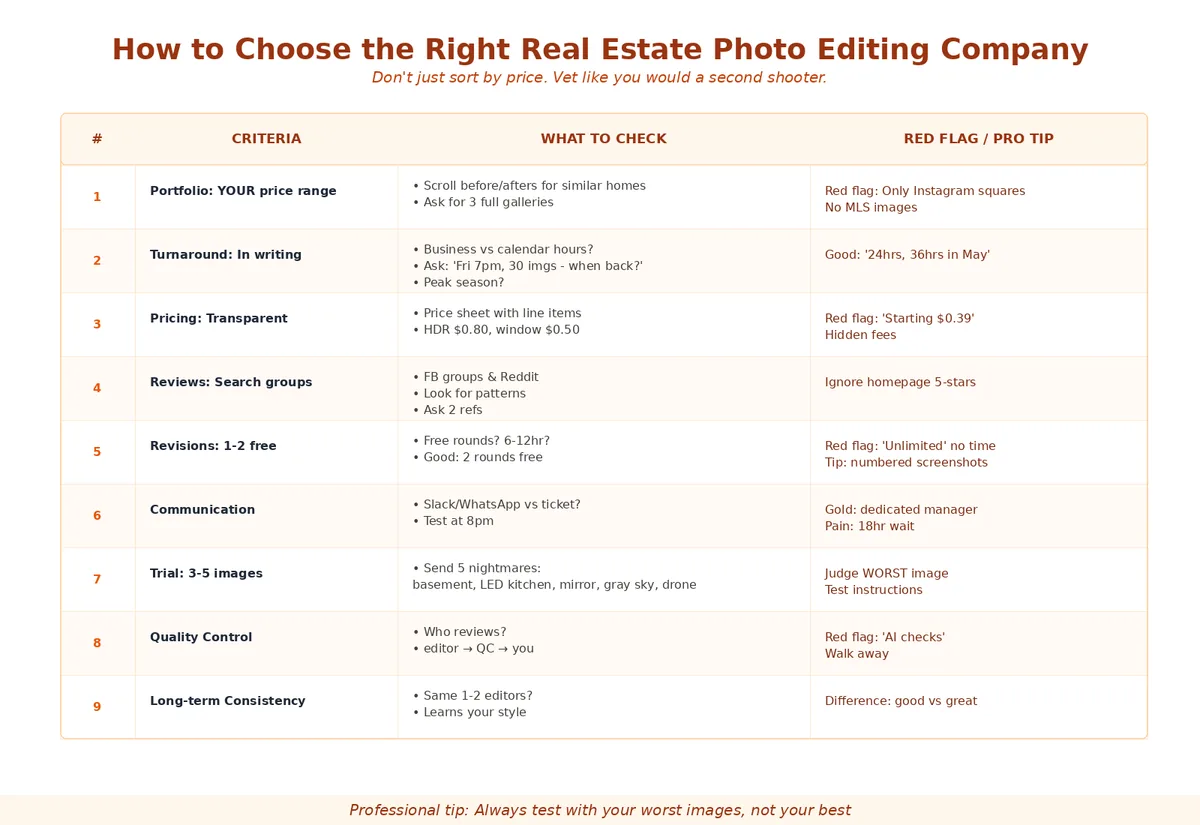
How to Choose the Right Real Estate Photo Editing Company
1. Portfolio: Look for homes in YOUR price range
A company showing only $2M modern mansions with floor-to-ceiling glass won’t know what to do with your $250k starter home with yellow walls and small windows. Luxury editing is often dark and moody; starter homes need to be bright and clean.
What to do
Scroll through their before/afters. Do you see properties like yours — similar lighting, similar clutter, similar markets? Ask for 3 full galleries (not just hero shots). If every sample is a twilight mansion, keep looking.
Red flag: Only Instagram squares, no full MLS-sized images. Means they’re hiding something.
2. Turnaround: Get it in writing
“24-hour turnaround” means nothing until you know if that’s 24 business hours (Mon-Fri) or calendar hours. If you upload on Friday at 6pm, will you get the files on Saturday at 6pm or Monday at 6pm?
What to ask
“If I upload 30 images on Friday at 7pm EST, what time will I get them back, and is that guaranteed?” Get it in email, not chat.
Also, ask about peak season. In April and May, everyone is slammed. Good companies will tell you upfront: “Standard is 24hrs, during May it may be 36hrs.”
3. Pricing: Transparent beats “contact us.”
You need a price sheet, not a sales call. Look for line items: HDR blend $0.80, window pull $0.50, sky replacement $1.50, rush +50%.
Why it matters: Without this, your $30 house becomes $67 because they charged extra for “complex windows” you didn’t know about.
Red flag: “Starting at $0.39” — that’s AI basic, not human editing. Or hidden fees for revisions, file renaming, or Dropbox delivery.
Ask: “What is included in the base price, and what triggers an upcharge?”
4. Reviews: Search photographer groups, not their website
Every company has 5-star testimonials on its homepage. Real feedback lives in Facebook groups like “Real Estate Photography” or Reddit discussions.
What to do (Outsource Real Estate Photo Editing Company Research)
Search “[Company Name] review” in those groups. Look for patterns: “great first month, then quality dropped” or “missed deadlines in spring.” One bad review is noise; five about the same issue is data.
Also, ask them for 2 photographer references you can DM. A legit company will give them.
5. Revisions: 1–2 free is standard
You will need tweaks. Maybe the windows are too bright, or the grass is too green.
What to ask
“How many revision rounds are free, and what’s the turnaround on revisions?” Good answer: “2 rounds free, returned within 6–12 hours.”
Red flag: “Unlimited revisions” with no time limit — that usually means slow service. Or charging $0.25 per image per revision.
Pro tip: Send revision notes with numbered screenshots, not “make it brighter.” Saves you a second round.
6. Communication: Slack vs ticket system
When something goes wrong at 9pm before MLS, do you get a human or an auto-reply?
A Slack channel or WhatsApp with a dedicated account manager is gold. A ticket portal where you wait 18 hours is painful.
Test it
During your trial, send a question at 8pm your time. See how fast and how clearly they respond. If they take 12 hours to answer a sales question, imagine support later.
7. Trial orders: Use the free 3–5 images — but do it right
Don’t send your easiest sunny living room. That’s useless.
Send 5 nightmare files:
- Dark basement with a blown window
- Kitchen with mixed LED
- Bathroom with a mirror reflection
- Exterior with gray sky
- Drone shot with haze
What you’re testing (Real Estate Photo Editing Outsourcing Trial Test)
Not just quality, but do they follow instructions? Did they read your note about “no sky replacement”?
Judge the worst image in the set, not the best.
8. Quality Control: Is a senior editor checking?
Cheap services have one editor do it all and ship it. Better companies have a two-step process: editor → QC lead → you.
What to ask
“Who reviews my images before delivery?” If they say “our AI checks,” walk away for anything above basic work.
You want a human who catches the crooked vertical or the window pull halo you missed.
9. Long-term consistency: Will you get the same editor?
This is the difference between good and great. If you get a random editor every time, your style drifts.
Best companies assign 1–2 dedicated editors after your trial. They learn your preferences: “John likes warm interiors, cool exteriors, never replace sky on cloudy days.”
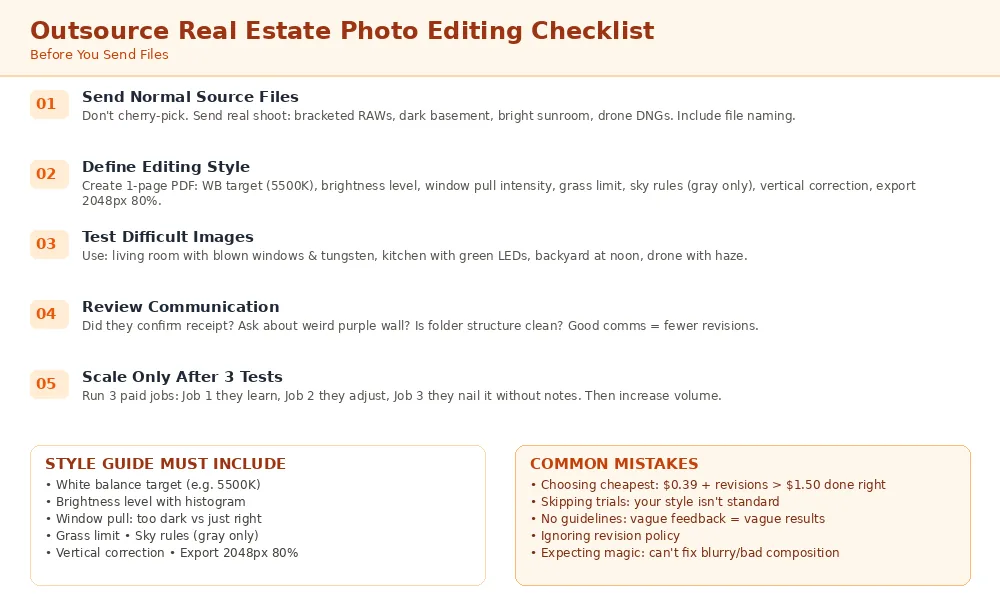
How to Test an Editing Partner Before You Scale
Send normal source files.
Don’t cherry-pick. Send a real shoot: bracketed RAWs, a dark basement, a bright sunroom, drone DNGs. Include your file naming. This shows them your real workload.
Define the Editing Style Before You Outsource Real Estate Photo Editing
Create a one-page PDF with:
- White balance target (e.g., 5500K)
- Brightness level (example image with histogram)
- Window pull intensity (show “too dark” vs “just right”)
- Grass color limit
- Sky replacement rules (only if gray)
- Vertical correction (always correct, or keep a slight perspective?)
- Export specs (2048px long edge, 80% quality)
Test Difficult Images
Use:
- a living room with blown windows and tungsten lamps
- a kitchen with green under-cabinet LEDs
- backyard shot at noon
- a drone photo with haze
If they handle these, your standard interiors are easy.
Review Communication
- Did they confirm receipt?
- Did they ask about the weird purple wall?
- Is the folder structure clean?
Good communication predicts fewer revisions.
Scale Only After Successful Tests
Run three paid jobs.
- Job 1: They learn.
- Job 2: They adjust.
- Job 3: They should nail it without notes.
That’s when you increase volume.
Common Mistakes People Make
- Choosing the cheapest: A $0.39 edit that needs two revisions and makes you re-edit
- yourself costs more than $1.50 done right.
- Skipping trials: Your style isn’t “standard.” Test first.
- No guidelines: Vague feedback creates vague results.
- Ignoring revision policy: Some charge after one tweak. Know upfront.
- Expecting magic: Editors can’t fix blurry images, terrible composition, or a room shot into direct sun with no brackets.
How Much Does Real Estate Photo Editing Outsourcing Cost? (2026 Breakdown)
In 2026, pricing is tiered by human vs AI and complexity.
Basic photo editing runs $0.05 to $15.00 per image — AI handles simple exposure for $0.05–$0.08, while human specialists charge $0.50–$15.00+ for detailed work.
Real Market Examples
- PhotoUp lists $0.50 per image for standard editing, with services ranging broadly from $0.15 to $25 per image, depending on add-ons.
- Philippines-based teams often quote $0.60–$1.50 for HDR blend and color.
- Upwork freelancers start at $2 per image for normal editing, and $5 per image for complex retouching like object removal and sky replacement.
- Add-ons
- Window pull: +$0.50–$1
- Sky replacement: +$1–$2
- Lawn enhancement: +$1–$2
- Object removal (simple): +$2–$4
- Virtual staging: $15–$35
- Day to dusk: $4–$8
- Rush (under 12 hrs): +50–100%
Sample Math
25 images per house × $1.20 average = $30 editing cost.
If that saves you 2.5 hours, and you value your time at $100/hr shooting, you net $220.
Real Estate Photo Editing Companies to Know
Keep this informational, not a sales list.
PhotoUp is frequently cited in 2026 roundups for fast editing and virtual staging, with affordable pricing starting around $0.50 per image and 12–24 hour turnaround.
BoxBrownie offers a pay-per-picture model and is known for competitive pricing and quick delivery.
PixelShouters provides real estate photo editing, virtual staging, and video editing, including twilight conversion and lawn replacement.
FixThePhoto is a larger retouching house used by many agents for detailed object removal and high-end interior work.
Test two providers side-by-side. Most pros keep one primary and one backup for peak weeks.
Signs You’ve Found the Right Outsourcing Partner
- Consistency: job 20 looks like job 2
- Predictable turnaround, even on busy Mondays
- They ask clarifying questions before editing
- Style memory — no reference needed after week two
- Revisions returned in hours, not days
- You can double your shots without warning them
When you stop opening every file at 100% zoom, you’ve outsourced successfully.
Frequently Asked Questions About Outsourcing Real Estate Photo Editing
Quick answers for real estate photographers comparing editing partners, turnaround times, revisions, file delivery, and common add-on services.
Is outsourcing real estate photo editing worth it?
Yes, if editing is taking time away from shooting, client communication, or delivery. Most photographers see the value when a 25- to 40-image listing can be uploaded at night and reviewed the next morning instead of edited after hours.
Can I outsource HDR editing?
Yes. HDR blending is one of the most common real estate photo editing services to outsource. Send the bracketed RAW files, your style reference, and any notes about window detail, brightness, and color so the final images match your usual look.
How do revisions usually work?
Most editing teams include one or two revision rounds within a set time window. The best way to get faster fixes is to send clear notes or marked screenshots instead of broad comments like “make this better.”
Are my RAW files secure when I outsource editing?
Use an editing company that offers private upload links, controlled access, and a clear file-retention policy. For luxury listings or sensitive properties, ask about NDAs and when source files are deleted after delivery.
How long does real estate photo editing take?
A normal turnaround is usually 12 to 24 hours, depending on the service, order size, and time zone. Rush delivery may be available for urgent MLS deadlines, but it is better to confirm rush pricing before production starts.
Can an editing company match my photography style?
Yes, but you need to give them a clear reference. Send 5 to 10 finished examples, your preferred brightness and warmth, window style, sky rules, and notes about what should never be changed.
Is virtual staging included with normal photo editing?
No. Virtual staging is usually a separate service because it involves furniture rendering, scale, shadows, and style selection. It normally costs more than standard HDR editing or basic retouching.
Can drone and aerial images be edited too?
Yes. Drone photos can be edited for haze, color, sky detail, lens distortion, horizon straightening, and sharpening. For best results, send DNG or RAW files instead of compressed JPEGs.
What files should I send to a real estate photo editor?
Send RAW brackets, final JPEG requirements, your preferred file names, room notes, and a small folder of finished edits that show your style. Avoid sending only low-resolution JPEGs if you expect detailed window pulls or color correction.
How should I test a new real estate photo editing company?
Start with a small but realistic batch: one bright interior, one dark room, one exterior, one image with clutter, and one difficult color-cast photo. Judge consistency, communication, revisions, and whether the editor follows your instructions.
Will my clients know I outsourced the editing?
Usually no. Agents and property teams notice clean, consistent listing photos and faster delivery. As long as the editing style matches your brand, outsourcing feels like a smoother workflow, not a visible handoff.
Should I use AI editing or human editors?
AI can help with simple exposure or fast volume work, but human editors are still better for window pulls, mixed lighting, object removal, sky replacement, and images that need to look natural on MLS and property websites.
Conclusion
When you outsource real estate photo editing correctly, you don’t lose creative control — you gain leverage. The edit becomes a system, not a nightly grind. You shoot more, deliver faster, and actually have energy for the business side.
Start with one test house. Document your style. Compare two providers. Measure not just the photos, but your time back. The right partner won’t feel like a vendor; they’ll feel like the night shift you always wished you had.