
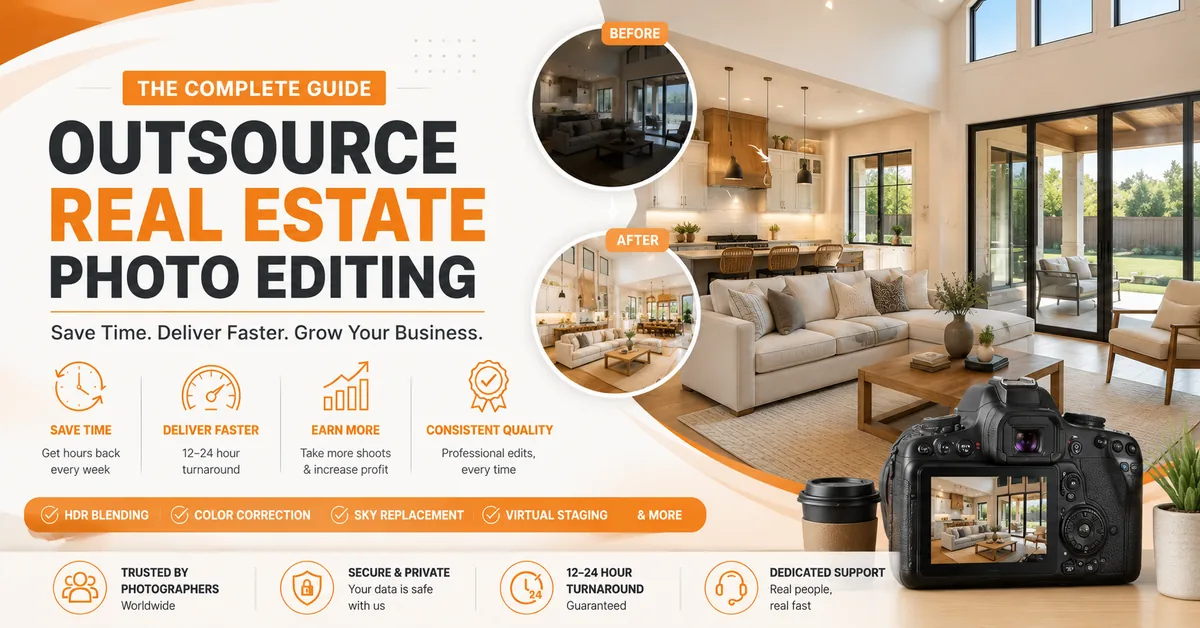
Outsourcing real estate photo editing means handing post-production to an external editor or team while keeping control of your photography style, delivery requirements and client relationship. It can help when editing limits your shooting schedule, but the useful test is whether the finished gallery meets your standards with less total work on your side.
This checklist is for real estate photographers and property-media teams evaluating an editing partner. If you are ready to discuss a managed workflow, review our real estate photo editing services and editing examples.
What does it mean to outsource real estate photo editing?
You provide source photos, editing instructions and output requirements. The editor processes the files, checks the results and returns the agreed deliverables. You review the gallery before sending it to your client or publishing it.
The handoff may cover one difficult image, a complete property or recurring work. A freelance editor, managed team and automated editing tool can each suit different needs. Compare their actual output, communication and revision process rather than assuming one model is always better. Our software-versus-service comparison explains the tradeoffs.
When does outsourcing fit your business?
It is worth testing when your editing queue delays agreed delivery, takes time away from paid shoots, or produces inconsistent results across photographers. It may also provide backup during busy periods. A small workload or a highly individual editing process can still favor in-house work.
Measure the whole workflow
Record the time you spend preparing files, writing notes, reviewing results, requesting revisions and delivering the final gallery. Compare that with your current process. A low editing rate is not a saving if repeated corrections consume the time you intended to recover.
Use your own records to evaluate capacity and profitability. Outsourcing does not by itself establish higher property sale prices, additional bookings or a particular return on investment.
Which services can you outsource?
- HDR exposure blending: combining bracketed source exposures while preserving natural room depth, material color and window detail. See our HDR editing service.
- Enhancement and retouching: white balance, exposure, verticals, lens correction and agreed detail cleanup. See photo enhancement and retouching.
- Object removal: specifically requested distractions, with careful reconstruction where the source material allows it. Identify each item rather than asking for unrestricted cleanup.
- Day-to-dusk editing: an exterior transformation with a believable sky, balanced light and clear disclosure where your publishing rules require it. See day-to-dusk editing examples.
- Virtual staging and renovation: separately specified digital alterations. Keep these distinct from ordinary exposure and color correction. See virtual staging.
- Aerial editing: color, horizon, exposure and other agreed corrections to drone images.
For a realistic finish, ask the editor to preserve the actual property, permanent features and genuine window views. Do not use retouching to conceal defects or invent a view. Confirm applicable listing-platform rules with the publishing party; a provider’s general claim of compliance is not a substitute for those requirements.
How to compare a real estate photo editing company
Ask to see full-property examples as well as individual images. A strong exterior does not tell you whether the same team can maintain wall color and exposure across adjoining rooms.
- Style matching: can the editor follow your references for brightness, warmth, shadow depth and window treatment?
- Quality control: who checks edges, verticals, color and consistency before delivery?
- Turnaround: when does the clock start, and how do incomplete files, volume, weekends or extra work affect it?
- Revisions: what is included within the agreed brief, and what counts as a new request?
- Communication: how are unclear instructions resolved, and who handles an urgent correction?
- File handling: what transfer method, access controls and retention arrangements will be used?
- Continuity: how are style notes retained and production coverage handled?
Judge the answers against a real test. Avoid selecting a provider solely from a promised image count, headline turnaround or an isolated testimonial.
Test the workflow before moving regular orders
- Choose representative files. Include a bright-window interior, mixed-light room, adjoining-room sequence and exterior. Add a difficult retouching request if it reflects your usual work.
- Supply usable source exposures. Keep brackets grouped and named consistently. Highlight missing exposures, movement or source limitations.
- Send a style reference. Explain what you like about it. State what must remain unchanged and whether sky replacement or other alterations are allowed.
- Agree scope and delivery. Confirm the selected test, quote, deadline, output sizes and revisions before production begins.
- Review the set. Compare related rooms together, then inspect problem areas at full resolution.
- Test feedback handling. Give specific, image-numbered notes and check whether corrections follow the brief.
Sample review checklist
- Wall, cabinet and floor colors remain believable across the gallery.
- Window edges are clean, with no pasted-in view or excessive darkening.
- Door frames and architectural verticals are straight without distorted proportions.
- Shadows retain depth; bright areas preserve recoverable detail.
- Moving objects do not create distracting ghosts between exposures.
- Retouching avoids repeated textures, broken edges and missing permanent features.
- Files match the agreed count, names, sizes, formats and delivery deadline.
Log requested corrections and review time. One successful sample supports a small production trial; it does not establish unlimited capacity or guarantee every future delivery.
Compare quotes by the same editing scope
Ask whether the quote is per finished image, source exposure, property or batch. Confirm how HDR brackets, complex removals, staging, rush work and additional output formats are counted. Keep the comparison like for like.
Consider the editing charge alongside your preparation, review and revision time. Estimate your internal cost from actual time records rather than borrowing an industry savings percentage.
PixelShouters quotes work according to the source files, required edits, volume, delivery requirements and agreed additions. Send a representative brief for a quote; public example rates from another provider should not be treated as our offer.
Prepare a reusable brief for repeat orders
Keep a concise style sheet with approved references, preferred window brightness, color and shadow guidance, permitted alterations and export rules. Add image-specific instructions separately so a one-off request does not become a rule for every property.
For each order, provide the property or project identifier, source-folder link, finished image count, required service, deadline and time zone, output format and any exceptions. Use a private transfer method appropriate for the files. Avoid placing credentials or sensitive property details in public notes.
Confirm receipt of complete files and the agreed delivery time. Review a small run of regular jobs before increasing volume, using on-time delivery, correction rate and your own review time as practical measures.
Common questions about real estate photo editing outsourcing
Can an outsourced editor match my photography style?
A representative sample is the best way to check. Provide finished references and explain the specific treatment you want for color, contrast, shadows and windows. Retain an approved reference for subsequent orders.
How quickly can PixelShouters deliver?
Our standard turnaround for most listing edits is 12 hours after complete files and the brief are received and the job is confirmed. Confirm timing for your actual scope and volume before relying on it for a client deadline.
Should I send RAW files or JPEGs?
Send the source files appropriate for the agreed service. HDR blending needs the available bracketed exposures. A compressed JPEG may limit highlight recovery and detailed corrections, so ask the editor to assess source limitations before approving the work.
Is virtual staging included in standard photo editing?
Do not assume it is included. Specify staging, renovation and substantial object removal separately so the quote, delivery time and disclosure requirements are clear.
Can I keep some editing in-house?
Yes. You can retain culling, style direction or selected retouching and outsource the agreed production steps. Define who owns final quality control and avoid overlapping edits that create inconsistent versions.