
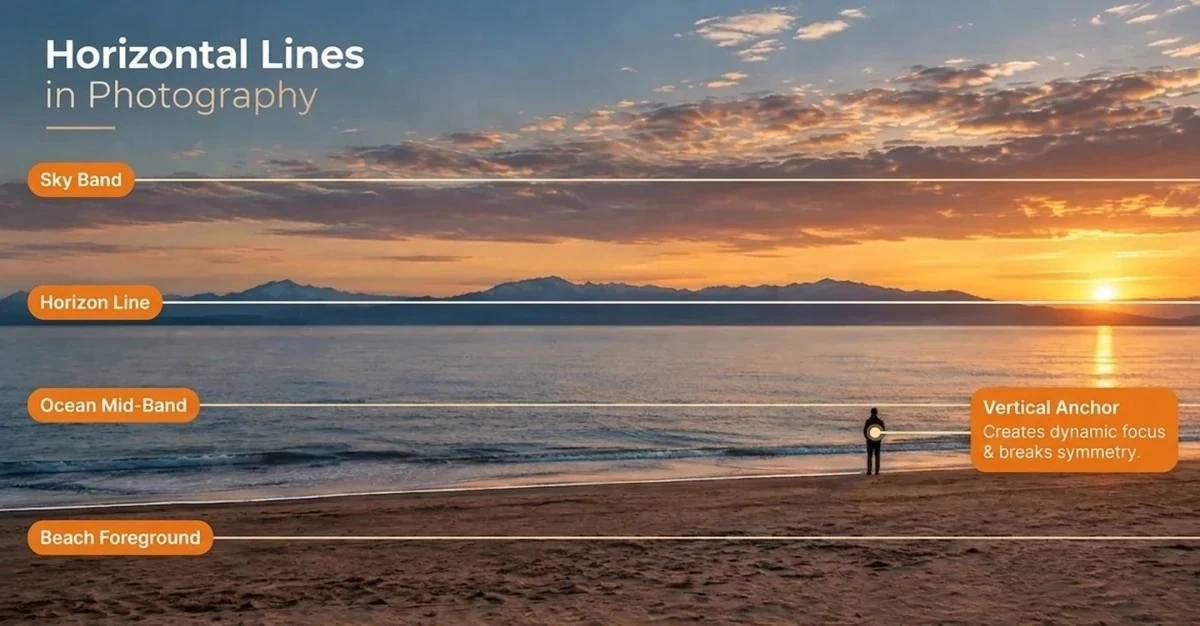
Horizontal lines in photography = calm and stable, but lifeless alone. Layer 3-5 colors for depth, break the horizon with one subject for tension, and use reflections for symmetry — that’s how you make a flat line feel 3D.
I have to be honest about something. For the first two years, my landscapes were straight up boring.
I’d get up at 4 AM, drive to the coast, see this insane sunrise with my own eyes, shoot 300 photos feeling like a genius, come home, open Lightroom… and it was just flat. Lifeless. Like I had just split the image in half with a ruler.
It took me a long time to figure out why. It wasn’t my camera. It was how I was handling the horizontal line.
If you searched for horizontal lines in photography or you’re trying to understand what is a line in photography, you’re already ahead of where I was. Once you learn to actually use horizontal lines instead of just letting them happen, everything clicks.
Let me explain it properly, the way I wish someone had explained it to me.
Table of Contents
What Is a Line in Photography?
In art school they teach you the 7 elements of art. Line is number one. Before color, before shape, before texture. Line is first.
So what is a line in photography really?

It’s just a path your eye follows without you even telling it to.
Your brain is wired to find lines and ride them like a train track. You don’t scan a photo randomly. You look for a line and you follow it.
There are two kinds of lines and this matters a lot for using lines in photography:
1. Real, physical lines: You could touch them if you were there. A pier going into the ocean. The edge of a road. The top of a table. A fence. The actual horizon where the sky meets the water. The stripes on a shirt.
2. Implied lines: There’s nothing actually there, but your brain invents the line. Three pelicans flying across the sky at the same height — there’s empty sky between them, but you connect them and you see a line. Or a person looking off to the left. That gaze is an invisible line. You will automatically follow it to see what they’re looking at.
That’s the entire game of lines in composition. Every single photo is full of lines in photography. Your job isn’t to find them, your job is to pick which line is the boss. Which line tells the viewer where to look first, second, and third.
If you don’t pick, the viewer’s eye wanders and they click away. That’s why understanding the photography of lines is non-negotiable.
What Are Horizontal Lines in Photography?
A simple definition: any line that runs left to right across your frame, parallel to the top and bottom edge of your photo.
Yes, the horizon is the most obvious one. But if you only look for the horizon, you’re missing 90% of the good stuff.

Look around you right now, even inside. The edge of your desk. The top of your monitor. The window sill. A bookshelf. The shadow from your blinds on the floor. The stripes on a hoodie.
Outside it’s endless. A fallen log. Layers of mountains fading into the distance in Utah. The flat line of the ocean in Big Sur. A road stretching through the desert. Sand ripples after the tide. A fence line. Even a person lying down on a bench is a horizontal line.
And that lying down part is exactly why horizontal lines feel the way they do.
Why Horizontal Lines Feel Calm and Stable
Think about when you go horizontal.
You lie down to sleep. To rest. To relax. You stop fighting gravity.
We also live our whole lives moving on a horizontal plane. We walk forward, not up. The sun rises on a horizontal line and sets on a horizontal line, every single day of your life since you were born.
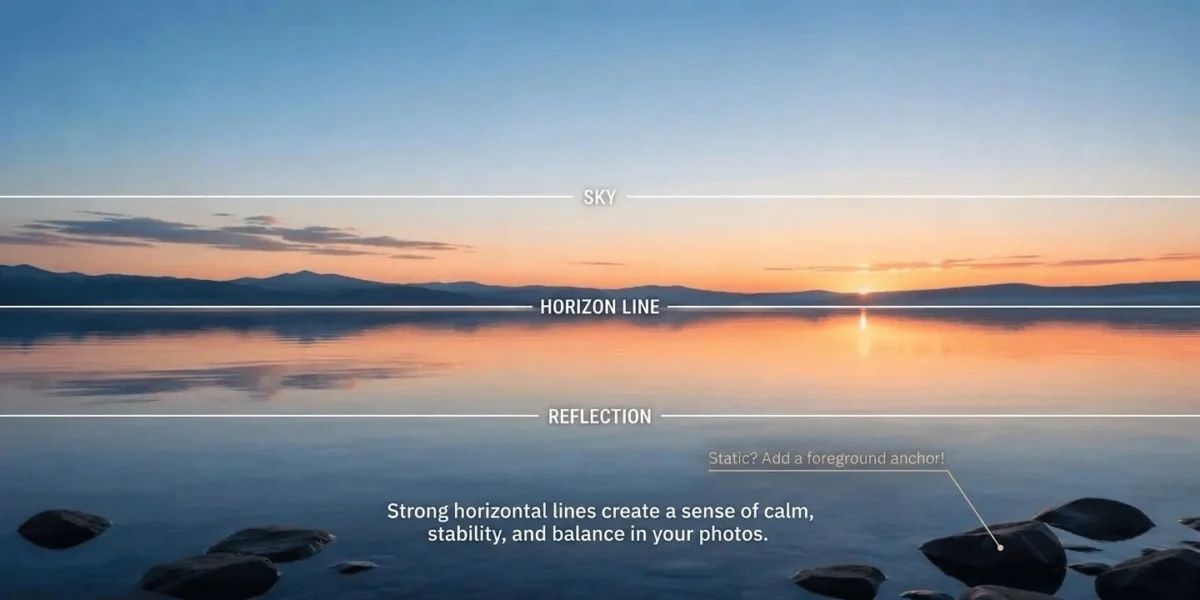
So when we see a strong horizontal line in a photo, our brain whispers: stable, safe. This is the psychology of horizontal lines that artists have used for centuries. Rest. No threat here. Timeless.
That’s why a photo of a perfectly still lake at 5 AM in Florida feels so peaceful. That long horizontal line composition tells your nervous system to exhale.
But here’s the trap I fell into for two years. Too much calm equals boring.
If you just put a straight horizon right dead center in the middle of the frame, from edge to edge, with nothing breaking it, you created the most static image possible. It’s a visual sleeping pill. You need to add a little tension back in. That’s what horizontal line composition is really about — controlling the calm so it feels powerful, not boring.
12 Types of Horizontal Lines You Can Find Anywhere
This is where you start beating everyone else. Stop hunting only for the skyline. Train your eye for these. This is real photography of lines.
1. The Classic Horizon: The ocean, a desert playa, the plains. This is the one everyone knows. It works best when the sky is doing something crazy — storm clouds, sunset color, stars.
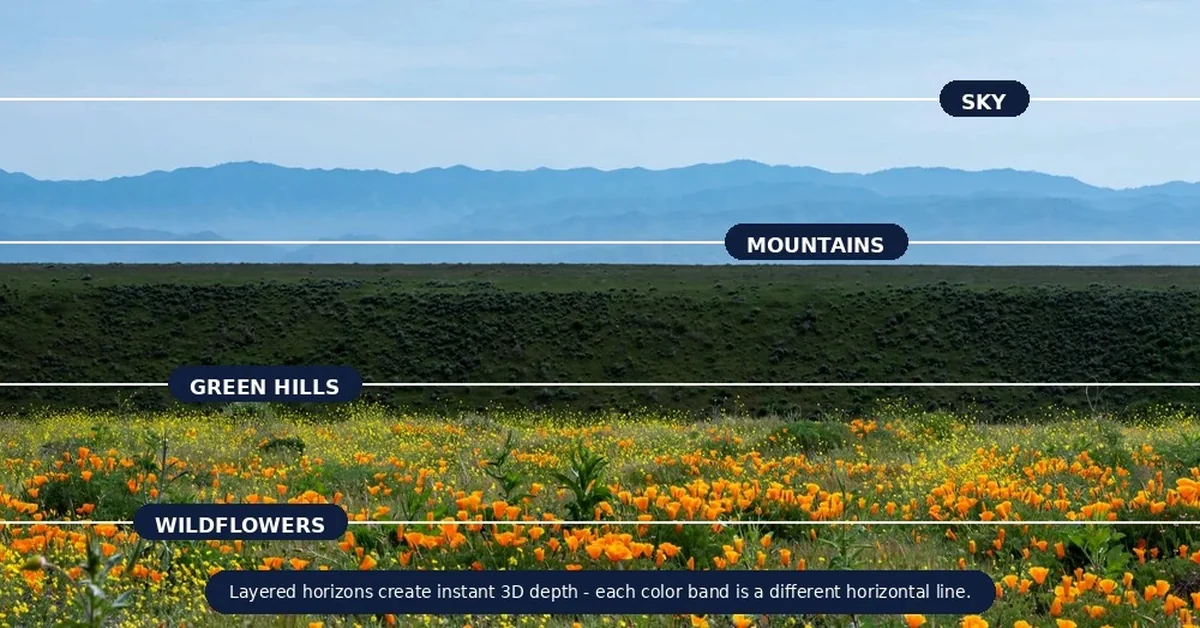
2. The Layered Horizon: My absolute favorite. You have 3-5 distinct bands stacked. In California I’ll get: yellow wildflowers in front, then dark green hills, then blue hazy mountains, then sky. Or at the Bonneville Salt Flats: white salt, then blue mountains, then sky. Each layer a different color. Instant 3D depth in a 2D photo.
3. The Broken Horizon: A horizon that is interrupted by something. A lone Joshua tree breaking the desert line. A lighthouse. A person standing on a pier. If you imagine a photo of a flat ocean with nothing — boring. Put one boat breaking that line — now you have a photo. Breaking the line gives the eye an entry point.
4. The Architectural Horizontal: Any city downtown is full of these. Rows of windows, balconies, the lines of a bridge, stair treads. Super clean, perfect for minimalist shots.
5. The Textural Line: Get close. Really close. Wood grain on a dock. Ripples in sand at low tide in Outer Banks. Close-up waves. Plowed farmland shot from a drone. These are all horizontal lines, but they become texture.
6. The Reflection Line: Where the real world meets its mirror in water. This is the ONE exception where you want your line dead center. Half real mountain, half mirrored mountain. It’s so satisfying because it’s symmetrical, but it has to be perfectly straight.
7. The Shadow Line: At 5 PM, shadows become thick, long horizontal stripes. A fence shadow across a road. Blinds shadow across a face. These are free horizontal lines that appear every evening.
8. The Color Block Line: Sometimes color itself creates the line. A bright yellow canola field under a deep blue sky. There’s no physical edge, but that color change is a powerful horizontal line.
9. The Minimalist Single Line: One tiny line in a huge empty space. A single pier disappearing into fog. A lone duck on a calm lake. A bird on a wire. This is pure line in photography — the power is in what you don’t include.
10. The Stacked / Repeated Lines: Think rice terraces, stadium seating, layers of fog in the Smokies. Repetition creates rhythm. Your eye bounces from line to line.
11. The Leading Horizontal: A long pier, a jetty, a long farm table. It runs left to right but also pulls you deeper to a subject sitting at the end of it.
12. The Implied Horizontal: Four buoys floating at the same height. People lying on the beach at the same line. Nothing physically connects them, but your brain draws the line anyway.
Horizontal vs Vertical vs Diagonal vs Curved
I wish someone had given me this breakdown early. None of your competitors explain this clearly:
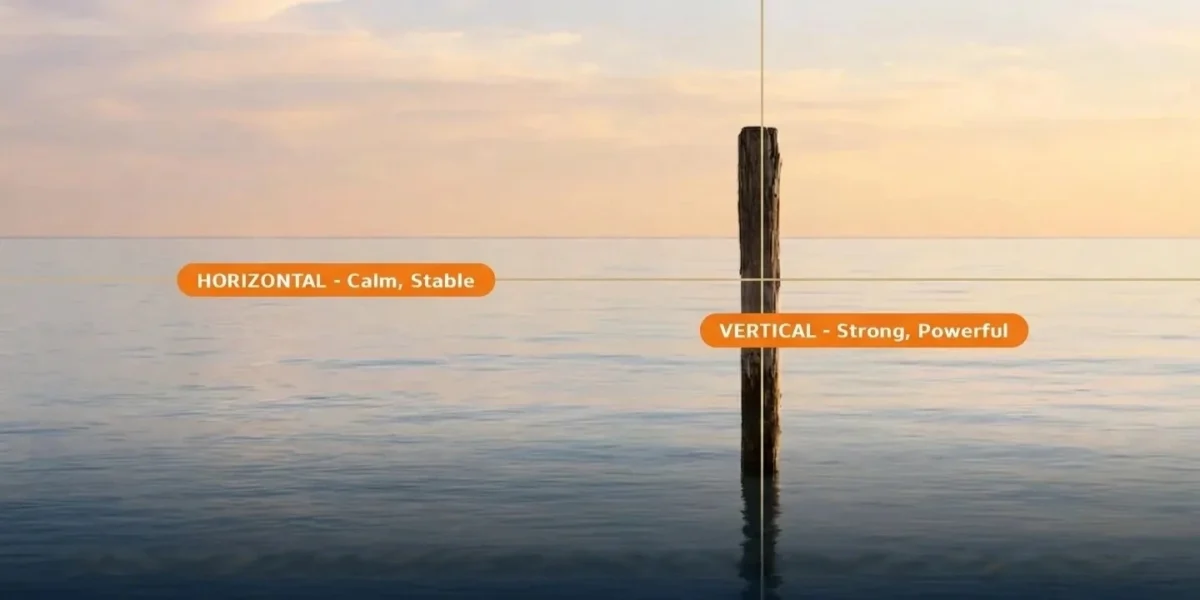
Horizontal lines: Feel calm, stable, restful, timeless. Low energy. Amazing for peace, vastness, serenity, minimalism. The risk: if you only use horizontals, it feels lifeless and boring.
Vertical lines: Feel powerful, strong, growth, dignity. Medium energy. Amazing for showing height and strength. Trees in Oregon, skyscrapers, a person standing tall. The risk: can feel rigid and formal.
Diagonal lines: Feel dynamic, movement, tension, excitement. High energy. Roads, trails, slopes. Amazing for action and depth. The risk: too many diagonals feel chaotic and unsettling.
Curved lines: Feel graceful, soft, natural, sensual. Flowing energy. Rivers, dunes, winding roads. Amazing for elegance. The risk: can feel too soft without a straight anchor.
The best photos I’ve ever taken mix them. My favorite ocean shot is 80% horizontal calm water, but with one vertical pier post cutting through it. That cross of calm + strong is what makes you stop scrolling.
How to Use Horizontal Lines — 15 Techniques
This is the core playbook for horizontal lines in photography. Don’t just include a line — use it on purpose.
1. The Rule of Thirds Placement — The One You Have to Master
Everyone says rule of thirds. Here’s why it actually works. If you put a horizon dead center, you split the image into two equal halves competing for attention. The brain doesn’t know where to look. When you put it on the upper third line, you’re saying “the ground is the story.” When you put it on the lower third line, you’re saying “the sky is the story.”
How to do it: Turn on the 3×3 grid in your camera. If your foreground has interesting flowers, rocks, footprints — put horizon on top line. If your sky has amazing clouds or color — put horizon on bottom line. Make it a conscious decision.
2. The Centered Reflection — When to Break the Rule
The only time you WANT dead center is perfect symmetry. A mountain and its perfect mirror in a lake at dawn. Half real, half reflection. When it’s centered and perfectly straight, it feels meditative and satisfying. If it’s even 1% off, it just looks like a mistake. So use a tripod for this one.
3. Break the Line to Create Depth
An unbroken line from edge to edge is a wall. It stops the eye cold. So let something intersect it. Let a person walk through it. Let a tree grow through it. Let a boat sit on it. That break is like a door that lets the viewer into the photo. Without it, they stay outside.
4. Stack and Layer Your Horizontals
Don’t look for one line, look for three or four. A good landscape is like a layer cake. Foreground wildflowers, mid-ground lake, background mountains, sky. Each layer should be a different brightness or color. This is how you make a flat photo feel deep. Telephoto lenses (like a 70-200mm) are amazing for this because they compress layers together.
5. Use a Horizontal Line to Divide Two Stories
Use a strong line like a fence, a wall, or a table edge to tell two stories in one frame. Kids playing below a railing, parents talking above it. Hands working below a table edge, faces above it. That line becomes a natural divider.
6. Make It Lead to Your Subject
Don’t let your horizontal line wander out of the frame into nothing. Put your subject at the end of it. A person standing at the very end of a pier. A cabin at the end of a long shadow line. The line becomes an arrow.
7. Frame Your Subject Between Two Horizontals
Look for a natural frame. Two horizontal shelves with a vase in between. The gap between two buildings where you see a distant mountain line. Even overexposed snow above and below a row of trees — that traps the eye right in the middle.
8. Shoot Wide and Horizontal for Maximum Calm
When you want to make people FEEL vastness — like the salt flats in Utah or a beach in Florida — shoot in landscape orientation, wide. Let that horizontal line have room to breathe left to right. Add lots of negative space above or below. It feels breathable and peaceful.
9. Shoot Vertical for Tension
Flip your camera 90 degrees. Now that long horizontal line gets chopped off on both sides. It feels trapped, a little tense. I love this trick. A tiny person against vast horizontal fog layers in a vertical frame — the vertical format makes the horizontal layers feel even more overwhelming. It adds drama.
10. Create Rhythm With Repeating Lines
Find a pattern of parallel horizontals — waves, farm terraces, modern building lines. Shoot the pattern. Then wait. Wait for one thing that breaks the pattern. One red kayak on a pattern of blue horizontal waves. One person standing on an empty beach line. That interruption is your focal point.
11. Low Horizon for Sky Drama
When the sky is on fire — sunset, storm clouds, stars — drop your horizon to the bottom 15-20% of the frame. Let the sky take 80%. But here’s the rule I learned the hard way: only do this if the sky is MORE interesting than the ground. A blank blue sky taking 80% of the frame is just 80% boring.
12. High Horizon for Ground Story
Opposite. If the ground is amazing — textured cracked mud, footprints in sand, a field of tulips — push the horizon to the top 15%. Let the ground dominate. This is how you make a small patch of flowers feel like an endless field.
13. The No-Horizon Shot
Some of my favorite abstract prints have no horizon at all. Just tight, cropped horizontal lines. Sand dunes filling the whole frame, just lines. No sky, no context. It becomes pure texture, pure photography of lines. It forces people to look at pattern, not place.
14. Combine Horizontal + Vertical for Balance
A frame that is ONLY horizontals feels sleepy. ONLY verticals feels stiff. Put them together. A vertical lighthouse against horizontal sea layers. A person standing vertical on a horizontal beach. That contrast creates energy while still feeling stable.
15. Create Your Own Horizontal Line With Shutter Speed
You don’t have to find a line, you can make one. At dusk, use a 2-3 second exposure and moving waves turn into soft horizontal silk. At night, car headlights become long horizontal light trails. You’re literally painting a horizontal line with light.
How to Keep Them Perfectly Straight
Here’s the truth: photo editors will reject your image in two seconds if the ocean is tilted. Even 1 degree matters. People feel it.
In the field:
Turn on your grid overlay AND your electronic level. Every modern mirrorless has it — Sony, Canon, Nikon, Fuji. It’s in the menu. Turn it on and leave it on.
If you’re shooting seascapes or anything with a distant horizon, use a tripod. Always. It’s impossible to handhold a perfectly level horizon when waves are moving and you’re excited.
I also carry a $10 hot-shoe bubble level in my bag. Tiny thing that slides into your flash mount. When I’m on uneven sand, that bubble tells me the truth.
Lens choice changes everything. My 16-35mm wide angle actually bends horizontal lines near the edges — barrel distortion. If I put the horizon near the top edge with a wide lens, it looks curved like the earth is bulging. So I keep horizons near the center when I’m super wide, or I fix lens correction in Lightroom.
A telephoto like a 100-400mm does the opposite — it compresses those layered mountain ridges so they look stacked tight on top of each other. That’s why those Smoky Mountains layered fog photos look so good — they’re shot long.
In Lightroom / Photoshop:
Even if you try, you’ll still mess up sometimes. In Lightroom Classic, go to Crop Tool, hit Auto, or use the Straighten slider and drag along your horizon. In Photoshop, use the Ruler Tool, draw along your crooked horizon, then click Straighten Layer.
But every time you straighten in post, you lose pixels and have to crop a bit. So get it right in camera first.
7 Mistakes That Are Ruining Your Horizontal Line Photos
I’ve done every single one of these.
1. The Slight Tilt: On the ocean, even half a degree of tilt looks like the water is about to pour out of the frame. Zoom in to 100% and check.
2. Cutting Through the Neck or Eyes: Classic portrait mistake. You take a nice portrait on the beach and that strong ocean horizon line goes right through the person’s neck or eyes, like you beheaded them. Crouch down a little so the horizon sits behind their shoulders, or stand up higher.
3. Dead Center for No Reason: If it’s not a perfect mirror reflection, don’t put your horizon dead center. It just chops your photo into two competing halves.
4. The Boring Sky Trap: You put your horizon low to show off the sky, but the sky is just empty, pale blue with no clouds. Now 70% of your photo is nothing.
5. Too Many Lines Fighting: I once shot a marina with 10 different horizontal lines — docks, boats, ropes, buildings, clouds. All competing. Eye had nowhere to rest. Simplify. Pick 2-3 strong lines and eliminate the rest by moving.
6. All Horizontal, No Counterpoint: A frame that is 100% horizontal lines feels dead. Always add one thing that’s NOT horizontal — a vertical post, a diagonal path, a person.
7. Ignoring Wide-Angle Distortion: That curved horizon at the edge of your wide shot isn’t artistic, it just looks like a mistake unless you meant it.
Where It Matters by Genre
Landscape and Seascape: This is where horizontal lines in photography live. Look for layered horizons at sunrise/sunset. Always have foreground interest — a rock, tide pool, flowers — to anchor that long line.
Architecture: Downtown is a goldmine. Repeating balconies, window rows. Use them for minimalist symmetry. Or include a tiny person to show massive scale vs those horizontal lines.
Portrait: Make your subject lie down, sit on steps, lean on a railing. A horizontal pose instantly feels intimate, relaxed, vulnerable compared to standing stiff. Just watch that background horizon.
Street Photography: Curbs, awnings, shadows, crosswalks. Use those horizontal anchors to give order to a busy street scene. They calm the chaos.
Minimalist / Abstract: This is pure line in photography. One horizontal line, huge empty space. One pier in fog. One bird on a wire. The power is in what you leave out.
Train Your Eye — Do This This Week
If you want to actually get good at using lines in photography, don’t just read.
Day 1-2: Only shoot ONE strong horizontal line per photo. Nothing else. Forces you to simplify.
Day 3-4: Find a location with at least 4 distinct horizontal layers and shoot it at golden hour.
Day 5: Shoot a whole set with NO horizon visible. Just horizontal texture.
You’ll start seeing lines in composition everywhere after that — at the grocery store, driving, walking.
FAQ
What is a line in photography?
A line in photography is a visual path your eye follows from one point to another. It can be real like a road or pier, or implied like a person’s gaze or a row of birds. It’s used to create direction, emotion, and structure.
What do horizontal lines mean in photography?
Horizontal lines convey stability, calm, rest, and timelessness. Because we associate horizontal with sleeping and with the natural horizon we see every day, they make an image feel peaceful, vast, and balanced. If overused without a break, they can feel static or boring.
Where should I place the horizon line?
Use the rule of thirds. Place it on the lower third to emphasize a dramatic sky, or on the upper third to emphasize an interesting foreground. Only center it for perfect mirror reflections or intentional symmetry.
How do you keep horizontal lines straight?
Turn on your camera’s grid overlay and electronic level, use a tripod with a hot-shoe bubble level for seascapes, and keep horizons away from the extreme edges when shooting ultra-wide to avoid distortion. Fine-tune with Lightroom’s Straighten tool.
What’s the difference between horizontal and leading lines?
All horizontal lines can be leading lines, but not all leading lines are horizontal. A horizontal leading line guides the eye side-to-side across the frame, often to a subject placed at its end, creating calm movement rather than dramatic depth.