
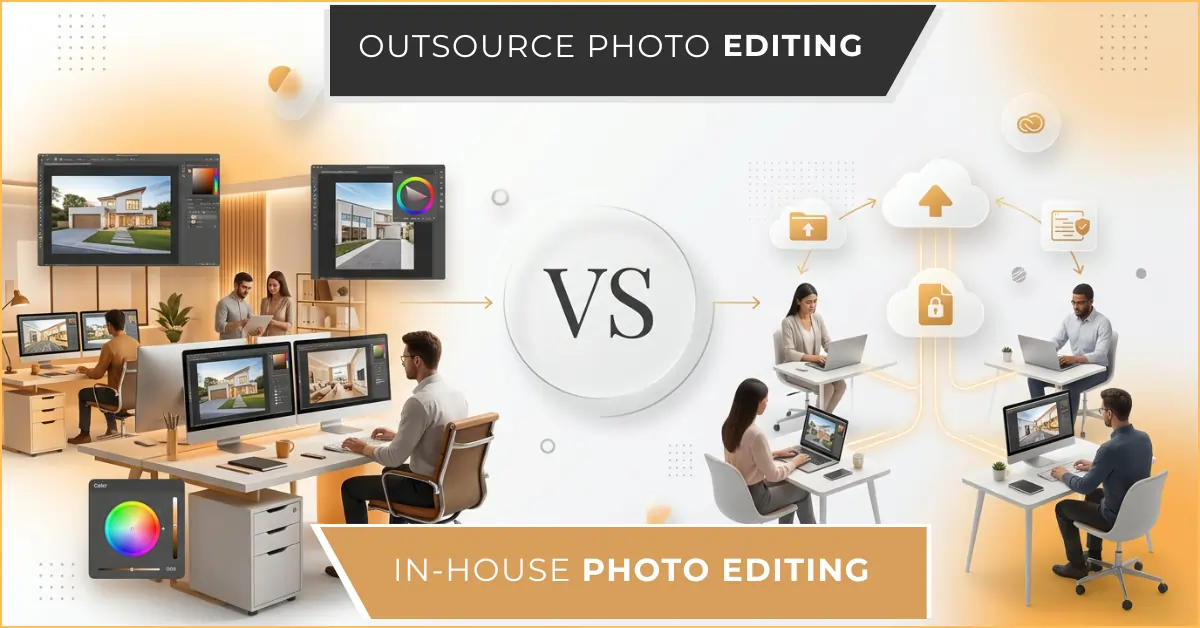
Your shoots are booked, but your edits keep piling up.
That’s when the outsource photo editing vs in-house choice gets real.
You shoot all day. Then you sit down to hundreds of photos waiting. Clients want them fast. You get tired, quality slips, and the backlog just grows.
Do you hire someone and spend months teaching them your style? Or do you send the work out and get your evenings back?
It’s not about what’s popular. It’s about what saves you time, keeps your photos looking right, and fits your budget.
Below I’ll keep it simple — real costs, speed, quality, and when each option works best — so you can pick what actually helps your business.
Quick Answer: Outsource Photo Editing vs In-House
If your monthly volume is unpredictable, deadlines are tight, or you need real estate photo editing services after every shoot, outsourcing usually wins on speed and scalability. In-house editing makes more sense when you need live creative direction, strict internal control, or a small, steady image load.
The practical answer is often hybrid: keep creative direction in-house, then use photo editing outsourcing for bulk editing, overnight turnaround, HDR blending, virtual staging, and overflow work.
Table of Contents
What In-House Photo Editing Really Means
In house photo editing means you own every step after the shutter clicks. Your editing team sits on payroll, in your office or remote on your systems.
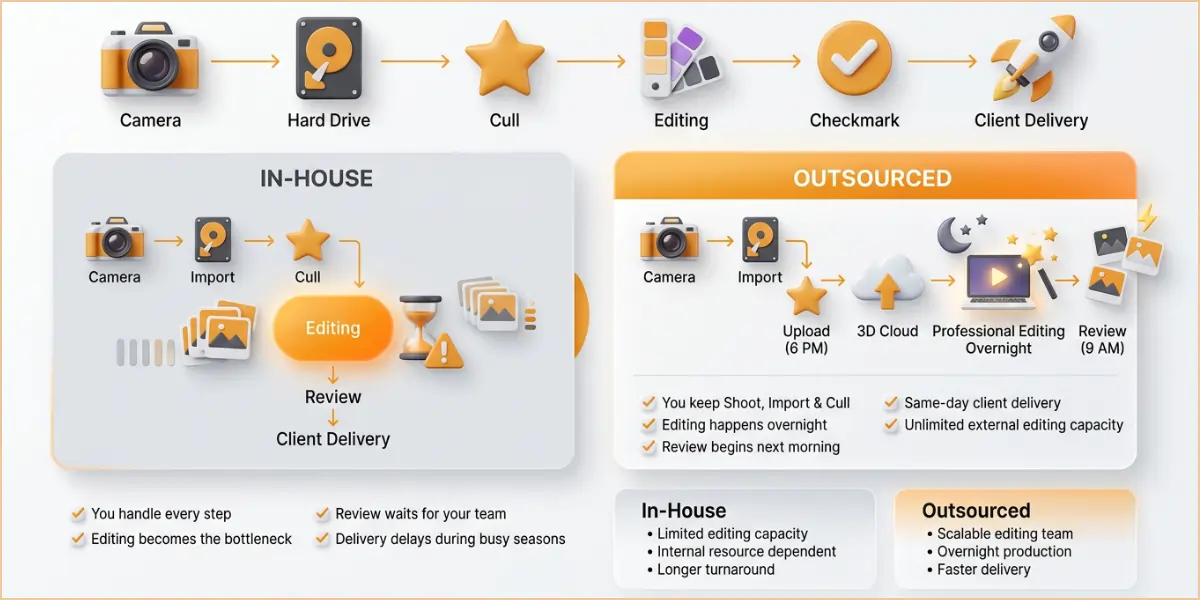
Typical workflow looks like this: import and cull, apply base corrections, retouch, quality check by a senior, export, and upload for client delivery. You buy the workstations, the calibrated monitors, the NAS storage, and the Adobe Creative Cloud seats. You choose the editing software stack and maintain updates.
Hiring is where reality hits. A junior retoucher needs 3-6 months to match your style consistently. A senior who can handle HDR photo editing, complex object removal, and color-critical fashion work commands a real salary. Training never stops because cameras change, styles evolve, and turnover happens.
Daily challenges are operational, not creative. Sick days leave you short-handed. Vacation means someone else absorbs the load. Quality management falls to you — creating SOPs, sample galleries, and feedback loops. Hidden responsibilities pile up: IT support, backup systems, electricity, HR paperwork, and the management time spent reviewing edits instead of shooting or selling.
Control is the payoff. You can walk over and adjust a skin tone in real time. For confidential campaigns, that matters.
What Outsourced Photo Editing Really Means
Photo editing outsourcing flips the model. You shoot, you cull, you upload. A dedicated photo editing company returns finished files.
The editing process is standardized: secure upload via portal, brief attached, first-pass edit by a specialist, internal QA, then delivery. Good partners build a profile for your style — your preferred sky replacement look, your day to dusk editing intensity, your ecommerce shadow rules.
Communication happens through a dashboard, Slack, or email. Revision systems are built in: mark up the image, request a tweak, get it back in hours. Editing turnaround time is the core promise. Most professional retouching teams offer 12-24 hour delivery, with overnight work because of time zones.
Scalability is the reason studios switch. Need bulk photo editing for 1,200 real estate images after a holiday weekend? An outsourced team adds retouchers without you interviewing anyone. You pay per image, not per seat, which changes editing costs from fixed to variable.
Quality assurance is managed by the vendor. They staff specialists for virtual staging, floor plan editing, panorama stitching, and perspective correction so you don’t have to train for each skill.
27-Factor Comparison
| Factor | In-House Editing | Outsourced Editing |
|---|---|---|
| Cost Structure | High fixed (salary, benefits) | Variable per image |
| Speed During Peaks | Limited by headcount | Scales instantly |
| Quality Consistency | Depends on training | Enforced by QA team |
| Hiring Required | Yes, constant | No |
| Training Time | 3–6 months per editor | Zero for you |
| Software Licensing | You pay full seats | Included |
| Equipment Investment | Workstations, monitors, NAS | None |
| Scalability | Slow, hire by hire | Immediate |
| Consistency Across Editors | Hard to maintain | Style guides + QA |
| Revisions | Internal time cost | Usually free within window |
| Availability | Business hours, sick leave | Often 24/7, 365 |
| Vacation Coverage | You cover gaps | Vendor covers |
| Expertise Depth | Generalists | Specialists per niche |
| Security & NDA | Direct control | Requires vetting vendor |
| Communication | Instant, in-person | Ticket/chat based |
| Project Size Handling | Capped | Handles 10 to 10,000 images |
| Workflow Integration | Fully custom | Needs onboarding |
| Deadline Pressure | Overtime costs | Built-in capacity |
| Long-Term ROI | Good at very high volume | Good at variable volume |
| Productivity Per Shoot | Editing steals shooting time | Frees shooting time |
| Business Flexibility | Low | High |
| Stress Level | High for owner/manager | Lower operational stress |
| Operational Complexity | HR, IT, management | Single vendor relationship |
| Technology Upgrades | You fund | Vendor funds |
| Growth Potential | Constrained by hiring | Unconstrained |
| Editing Turnaround Time | 2–5 days typical | 12–24 hours typical |
| Editing Quality Control | You build system | System provided |
Real Cost Analysis
Let’s talk numbers without the sales gloss.
Freelancer (500 images/month): In-house means one part-time editor at $2,000/month plus $80 for software, $150 amortized hardware. Total ∼$2,230. Outsourcing at $0.40 average for basic ecommerce photo editing = $200. Outsourced wins unless you need minute-by-minute control.
Small Studio (2,500 images/month): Two full-time editors ($7,000 salary), benefits ($1,400), software ($160), hardware replacement ($300), management time ($1,000), office/power ($400). ∼$10,260/month. Outsource image editing at blended $0.50 = $1,250. Even with a QA manager internally, you’re saving over $8,000.
Growing Agency (10,000 images/month): In-house team of 6-7 ($28,000+), plus overhead pushes you past $38,000. Outsourced bulk photo editing with volume pricing at $0.35 = $3,500. The difference funds marketing.
Enterprise (50,000+ images/month): Here in-house can make sense for core work. A 25-person team costs $150k+/month fully loaded. A hybrid model often wins: keep 5 senior editors for brand-critical work, outsource the 80% that is standard image enhancement, color correction, and clipping path.
Hidden costs tip the scale: recruitment fees, turnover (retouchers often leave after 18 months), sick leave, software true-ups, backup storage, and the opportunity cost of you editing instead of selling.
| Business Type | Monthly In-House | Monthly Outsourced | Annual Difference |
|---|---|---|---|
| Freelancer | $2,230 | $200 | $24,360 saved |
| Small Studio | $10,260 | $1,250 | $108,120 saved |
| Growing Agency | $38,000 | $3,500 | $414,000 saved |
| Enterprise Hybrid | $45,000 | $12,000 | $396,000 saved |
Decision Matrix
Industry Breakdown
Real Estate
Volume and speed rule. Agents want listings live in 24 hours. Outsourcing dominates because of HDR editing, sky replacement, virtual staging, grass enhancement, and day to dusk editing at scale. Keep one in-house editor for luxury property editing only if you shoot $2M+ homes daily.
Ecommerce
Consistency across 5,000 SKUs beats everything. Outsource photo editing for clipping path, ghost mannequin, color correction, and shadow creation. In-house makes sense for art-directed campaigns where the creative director needs instant feedback.
Wedding
Emotional style is personal. Many top wedding photographers keep editing in-house for the hero album, then outsource culling and basic corrections. Hybrid protects style while surviving October.
Portrait & Headshot
Low volume, high touch. In-house editing team often wins because clients expect same-day tweaks during the session.
Fashion & Jewelry
High-end retouching requires specialists. Most brands use creative outsourcing for production retouching and keep one senior for creative direction. Professional photo retouching services with jewelry experience save months of training.
Food, Travel, Automotive
All benefit from outsourced photo editing for volume, with in-house for hero images. Object removal and window masking are faster with specialists.
Outsource Photo Editing vs In-House Photo Editing Workflow
Hidden Costs Most Businesses Ignore
Recruitment fees for each retoucher. Training time where output is slow. Employee turnover means retraining every 12-18 months. Vacation and sick leave coverage. Hardware replacement every 3 years. Software licensing true-ups. Cloud storage and backup systems. Quality audits you must run yourself. Management time — the biggest cost — spent checking edits instead of growing revenue. Communication overhead when briefing junior editors repeatedly.
Hidden Benefits of Outsourcing
Access to specialists for virtual renovation, floor plan redraw, and lens distortion correction without hiring. Night shift productivity means you wake up to finished work. 24-hour workflow compresses editing turnaround. Bulk editing capacity for Black Friday or spring real estate rush. Consistent style enforced by QA, not hope. Lower operational stress. Predictable pricing per image helps editing ROI calculations. Access to advanced editing expertise you couldn’t afford full-time.
Hidden Advantages of In-House Teams
Brand familiarity grows over years. Immediate collaboration during a shoot. Creative brainstorming happens at the desk. Internal communication is instant. Confidential campaigns stay inside. Direct supervision for micro-adjustments.
Hybrid Model
Most profitable studios run hybrid. Keep one senior retoucher in-house for creative direction, client consults, and final color. Outsource 70-90% of production: culling, basic corrections, bulk photo editing, sky replacement, object removal. You get editing efficiency without losing control. This model handles editing capacity spikes and protects editing consistency.
Decision Tree
Should You Outsource Photo Editing?
FAQ
1. Is outsourcing photo editing cheaper than in-house?
For most businesses under 15,000 images monthly, yes. In-house carries salary, benefits, software, hardware, office, training, and management time. A fully-loaded junior costs $3,500-$5,000/month in the US. Outsourcing converts that to $0.30-$1.50 per image. At 2,500 images, you pay $750-$3,750 versus $10,000+ in-house. Calculate editing ROI by including your own time.
2. How fast is outsourced editing turnaround?
Standard is 12-24 hours for real estate photo editing, ecommerce, and portrait batches. Many offer 6-hour rush. Because teams work across time zones, you upload at night and receive by morning. In-house teams typically need 2-4 business days once backlog builds.
3. Will I lose quality control?
Not with the right partner. Professional photo editing services use three-stage QA: editor, senior reviewer, and your feedback loop. You provide 20-50 edited samples, they build a profile. Quality improves after the first 2-3 batches as they learn your preferences for HDR photo editing, color correction, and retouching intensity.
4. Is my work secure with an outsourcing company?
Vet for NDAs, encrypted portals, and no subcontracting without approval. Reputable vendors serving real estate and ecommerce brands handle thousands of confidential images daily. Ask about data retention policies and ISO 27001 compliance.
5. Can outsourced editors match my style?
Yes, if you document it. Provide before/after, LUTs, and notes on skin retouching, sky replacement style, and day to dusk editing preferences. Most achieve 95% match by batch three.
6. What about revisions?
Most include 1-2 free revisions within 48-72 hours. Mark changes clearly. Build a feedback sheet to reduce revision rates over time.
7. When does in-house make more sense?
When volume is low and variable, work is highly confidential, or you require instant in-person collaboration for creative direction. Portrait studios and luxury fashion houses often keep core editing internal.
8. How do I handle peak seasons?
That’s outsourcing’s strength. Wedding photographers triple volume in October. An outsourced team scales from 500 to 5,000 images without hiring. You avoid paying salaries in slow months.
9. What software do outsourced teams use?
Same as you: Lightroom, Photoshop, Capture One. For specialized work like virtual staging, floor plan editing, and panorama stitching, they have licensed tools you would otherwise buy.
10. Can I outsource just part of my workflow?
Absolutely. Common split: you cull, they edit. Or they do basic corrections, you do final creative grades. Hybrid preserves control while gaining editing scalability.
11. How do I compare editing costs accurately?
Add all in-house costs: gross salary × 1.25 for benefits, $80/month software, $3,000 workstation/36 months, $200/month storage, plus 10 hours of your management time. Divide by monthly images. Compare to per-image quote.
12. Does outsourcing work for bulk photo editing?
It’s built for it. Ecommerce catalogs with 10,000 images, real estate teams with 200 listings/month, and automotive dealers rely on bulk capacity. Consistency is enforced by automation and QA.
13. What industries benefit most?
Real estate, ecommerce, wedding, and product photography see fastest ROI due to high volume and standardized edits like background removal, window masking, and perspective correction.
14. How long to onboard?
3-7 days. You share samples, they do a test batch of 10-20 images, you give feedback, they lock the profile. After that, workflow is upload and download.
15. Will clients know I outsource?
No. Delivery is white-label. Files return with your naming, your metadata. It’s your brand.
16. What about complex edits like virtual renovation?
Specialists handle these daily. It’s more cost-effective than training in-house for occasional use.
17. How do I maintain consistency across seasons?
Use a style guide PDF and quarterly calibration batches. Good vendors assign a dedicated pod to your account.
18. Is hybrid better than full outsource?
For growing studios, yes. Keep creative control in-house, push production out. You get editing productivity without losing brand voice.
19. What are outsourcing risks?
Poor communication, style drift, missed deadlines. Mitigate with trials, clear SLAs, and starting with non-critical batches.
20. How do I switch from in-house to outsourced?
Start parallel for 30 days. Send 30% of work out, measure turnaround, quality, and cost. Keep in-house for rush jobs. Scale up as confidence grows.
Future Trends
AI-assisted editing will handle 60% of basic corrections by 2027, but human quality control remains essential for skin tones and brand color. Cloud collaboration will let in-house and outsourced teams work in the same catalog in real time. Remote editing teams will become pods dedicated to single brands. Workflow automation will route images by type automatically. Subscription-based editing will replace per-image pricing for predictable volumes. Specialized editing partners for luxury property editing and jewelry retouching will command premiums because expertise matters more than speed.
Evaluating a Partner: Where PixelShouters Fits In
After the first quarter of testing vendors, most studios look for the same thing: a team that already speaks real estate and ecommerce fluently, not a generalist who needs months of training.
That is where I often point people to look at providers like PixelShouters as a benchmark. Not because they are the only option, but because their service list mirrors what growing businesses actually need when comparing outsource photo editing vs in-house.
They cover the full production stack: Real Estate Photo Editing, HDR Editing, Virtual Staging, Day to Dusk Editing, Object Removal, Sky Replacement, Grass Enhancement, Floor Plan Redraw, Panorama Stitching, Virtual Renovation, Image Enhancement, Color Correction, Perspective Correction, Window Masking, Lens Distortion Correction, Batch Editing, Commercial Image Editing, and Luxury Property Editing. For operations, they emphasize Fast Turnaround, Bulk Editing, Quality Control, and Revision Support — the four things that break most outsourcing relationships.
Use a company like this to test your workflow: review a before-and-after portfolio, send 30 images, measure how closely they match your style guide, check actual delivery time, and see how they handle feedback. Whether you choose them or another photo editing company, that test tells you more than any sales call.
Final Decision Framework
The outsource photo editing vs in-house choice comes down to math and lifestyle, not loyalty to a model.
If your budget is tight, your volume swings monthly, and your growth plan depends on shooting more — not managing people — outsourcing gives you immediate editing capacity, lower overhead, and faster editing turnaround time. You convert fixed salaries into variable costs and buy back your evenings.
If your work demands live creative iteration, extreme confidentiality, or under 500 images monthly with a very specific artistic touch, an in-house editing team remains sensible. You pay more for control, and for some brands that premium is worth it.
Most successful businesses I advise land in the middle. They keep creative direction and final approval internal, and they partner with a professional photo editing services team for production. This hybrid approach delivers editing consistency, protects quality, and scales without the HR burden of constant hiring.
Before you decide, audit your last 90 days: count images edited, hours spent, true cost per image including your time, revision rate, and missed deadlines. That snapshot reveals whether editing is a profit center or a bottleneck.
If you want a low-risk test batch before changing your full workflow, contact PixelShouters with your image volume, turnaround target, and editing style.
Choose the model that lets you shoot more, deliver faster, and sleep better. Then revisit the decision every six months — because as your volume, team, and goals change, the right answer to outsource photo editing vs in-house changes too.