

Key Takeways: Stuck shooting a bit of everything? Here are 40 photography niches – from portrait and wedding to real estate, product, and aerial – plus which ones pay well, which fit your personality, and how to test the right one before you commit.
PORTRAITS_2023 with 800 photos I never culled. LANDSCAPES_ICELAND that I’ll “print someday.” Friend’s Wedding – FINAL FINAL. A bunch of dog photos. Food shots I traded for free coffee. Three random property shoots for an agent on Instagram. And my Instagram itself – travel, street, a macro of my cat’s eye, one lucky lightning shot.
Nothing in there was bad. But when someone asked what kind of photographer I was, all I could say was, “a bit of everything.”
If that sounds like you, it’s not a talent problem. It’s a direction problem.
I’m not here to rank the best photography niches. I’m here to show you what actually exists, how each one feels day-to-day, which ones can actually pay the bills, and how to test one without rebuilding your whole career on a guess.
Table of Contents
What Exactly Is a Photography Niche?
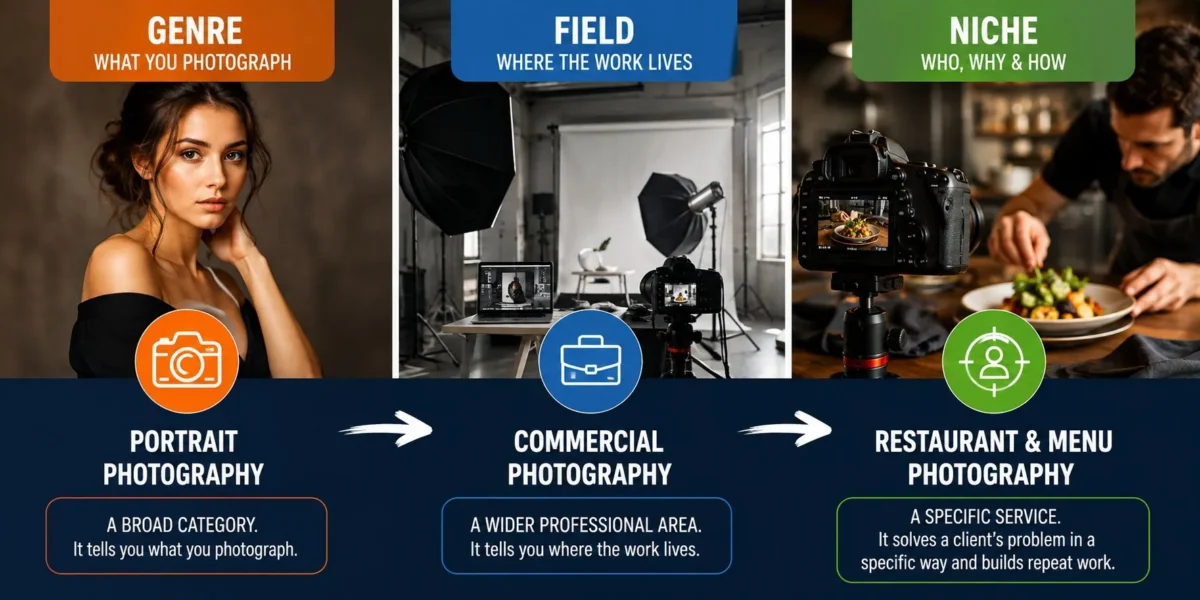
We throw three terms around like they mean the same thing. They don’t.
Photography genre is a broad category. Portrait photography. Landscape photography. Food photography. It tells you what you photograph.
Photography field is a wider professional area. Commercial photography. Editorial. Fine art photography. It tells you where the work lives.
Photography niche is more specific. A genre describes what you photograph. A niche also considers who you photograph for, why they need the images, and how the work is delivered.
Here is how that looks in real life:
Instead of just saying “portrait photography,” a business niche sounds like this: corporate headshots for growing tech companies that need consistent LinkedIn and website photos during hiring pushes.
Instead of “real estate photography,” a more defined niche could be: property photography for real estate professionals who need consistent listing imagery and fast post-production.
Instead of “food photography,” a niche could be: restaurant and menu photography for hospitality businesses updating delivery apps and social.
See the shift? You went from a topic to a service. You now have a client, a problem you solve, a deliverable, and a reason for them to come back. That is the difference between knowing types of photography and actually having a photography specialization you can market.
If you are exploring photography topics to build a business, that distinction is everything.
40 Photography Niches You Can Explore
This section is for discovery. I am not going to write 40 long essays. I want to give you enough to compare.
People & Portraits
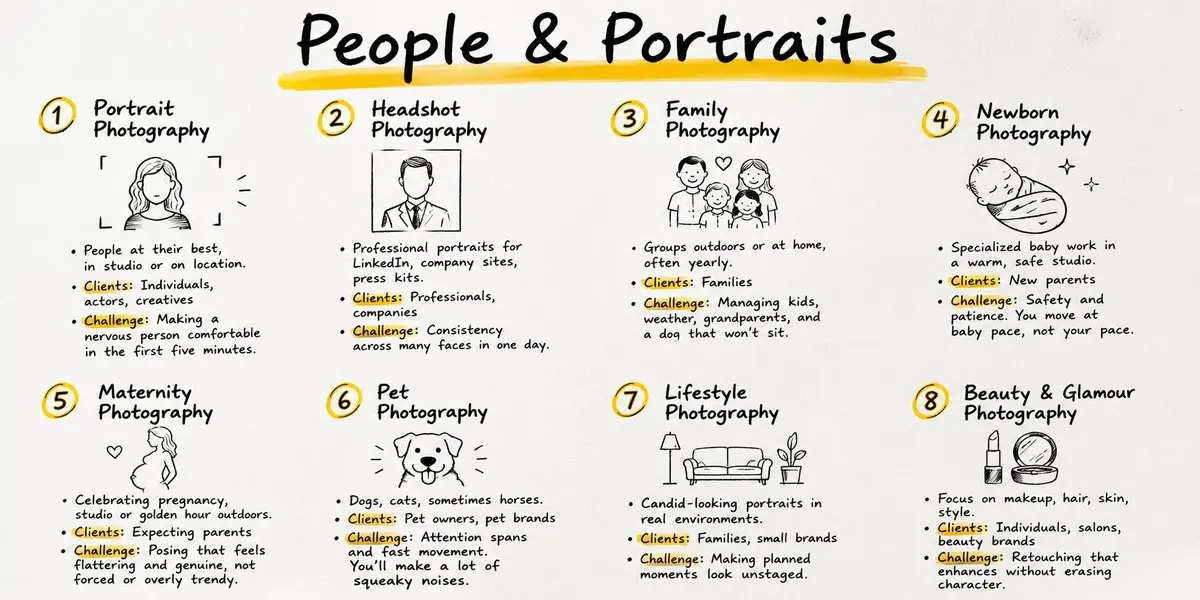
1. Portrait Photography
People at their best, in studio or on location. Clients are individuals, actors, creatives, everyday folks who want a good photo of themselves. I love it because light and direction change everything about a face. The hard part is making a nervous person comfortable in the first five minutes.
2. Headshot Photography
Tighter, professional portraits for LinkedIn, company sites, press kits. Clients are professionals and companies, often in batches of ten or twenty. Interesting because tiny tweaks affect credibility. Challenge is consistency across many different faces in one day.
3. Family Photography
Groups outdoors or at home, often yearly. Clients are families who want to document growth. It is rewarding because you witness real connection. The challenge is managing kids, weather, grandparents, and a dog that won’t sit, all at once.
4. Newborn Photography
Highly specialized baby work in a warm, safe studio. Clients are new parents. It is quiet, detailed, slow work with wraps and poses. The challenge is safety and patience. You move at baby pace, not your pace.
5. Maternity Photography
Celebrating pregnancy, usually studio or golden hour outdoors. Clients are expecting parents. Lovely for emotional storytelling. Challenge is posing that feels flattering and genuine, not forced or overly trendy.
6. Pet Photography
Dogs, cats, sometimes horses. Clients are pet owners and pet brands who treat animals like kids. Fun because every animal has personality. Challenge is attention spans and fast movement. You will make a lot of squeaky noises.
7. Lifestyle Photography
Candid-looking portraits in real environments, at home or at work. Clients are families and small brands wanting natural feel. Interesting for storytelling without stiff posing. Challenge is making planned moments look unstaged.
8. Beauty and Glamour Photography
Focus on makeup, hair, skin, style. Clients are individuals, salons, beauty brands. Interesting for precise lighting and refined retouching. Challenge is retouching that enhances without erasing character.
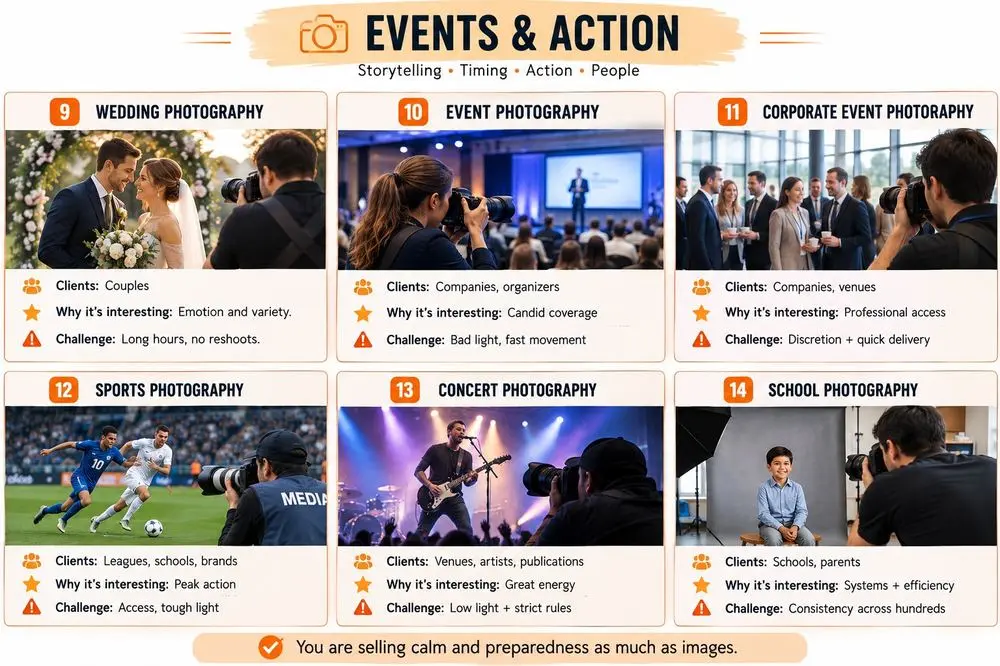
Events & Action
9. Wedding Photography
Full-day storytelling with no second chances. Clients are couples. You are part photographer, part logistics manager, part therapist. Interesting for emotion and variety. The hard part is long hours, no reshoots, and culling 3,000 plus images the next day.
10. Event Photography
Conferences, parties, launches, community gatherings. Clients are companies and organizers. Interesting for candid coverage and meeting people. Challenge is bad light, fast movement, being everywhere without blocking the event.
11. Corporate Event Photography
A subset focused on business audiences. Clients are companies and venues needing clean images for internal comms and marketing. Interesting for professionalism and access. Challenge is discretion and delivering usable images quickly.
12. Sports Photography
Peak action, decisive moments. Clients are leagues, schools, publications, brands. I love the anticipation of it. Challenge is access, tough light, and long waits for short bursts of action.
13. Concert Photography
Low light, loud music, tight photo pits. Clients are venues, artists, publications. Great energy. Challenge is usually three songs, no flash, and very strict rules.
14. School Photography
Volume portraits and events for schools. Clients are schools and parents. Interesting for systems and efficiency. Challenge is consistency across hundreds of kids and very tight schedules.
These niches share timing, anticipation, people skills, and reliable workflows. You are selling calm and preparedness as much as images.
Commercial & Brand Photography
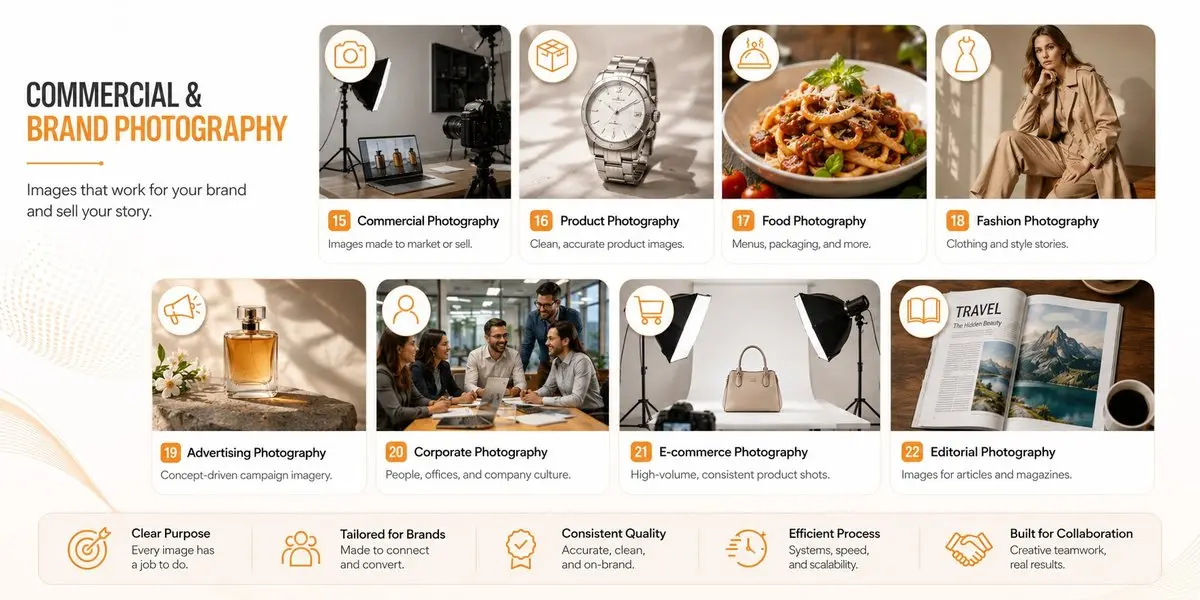
Commercial photography is different from personal photography because the images have a job to do. They need to help sell something.
15. Commercial Photography
Umbrella term for images made to market or sell. Clients are brands and agencies. Interesting for collaboration and creative briefs. Challenge is revisions, approvals, and clear usage terms.
16. Product Photography
Clean, accurate images of products for web and catalogs. Clients are e-commerce brands. Interesting for precision lighting. The hard part is dust, reflections, and perfect color accuracy. You will own a lot of canned air.
17. Food Photography
Menus, packaging, editorial, social content. Clients are restaurants and food brands. Interesting for styling and texture. Challenge is food wilts and melts fast, so you have minutes, not hours.
18. Fashion Photography
Clothing and style stories. Clients are designers, brands, magazines. Interesting for team creativity. Challenge is high production, many opinions, and long days.
19. Advertising Photography
Concept-driven campaign imagery. Clients are agencies and larger brands. Interesting for big ideas and art direction. Challenge is many stakeholders and detailed expectations.
20. Corporate Photography
People, offices, culture for companies. Clients are corporations and startups. Interesting for making offices look human. Challenge is mixed lighting and tight executive schedules.
For brands that need more than still imagery, combining professional photography with video production.
21. E-commerce Photography
High-volume product work for online stores. Clients are retailers with 200 SKUs to shoot this week. Interesting for systems and speed. Challenge is maintaining consistency when you are tired.
22. Editorial Photography
Images for articles and magazines. Clients are publications and brands with content needs. Interesting for narrative and style. Challenge is matching story tone and fast turnarounds.
Property, Architecture & Space
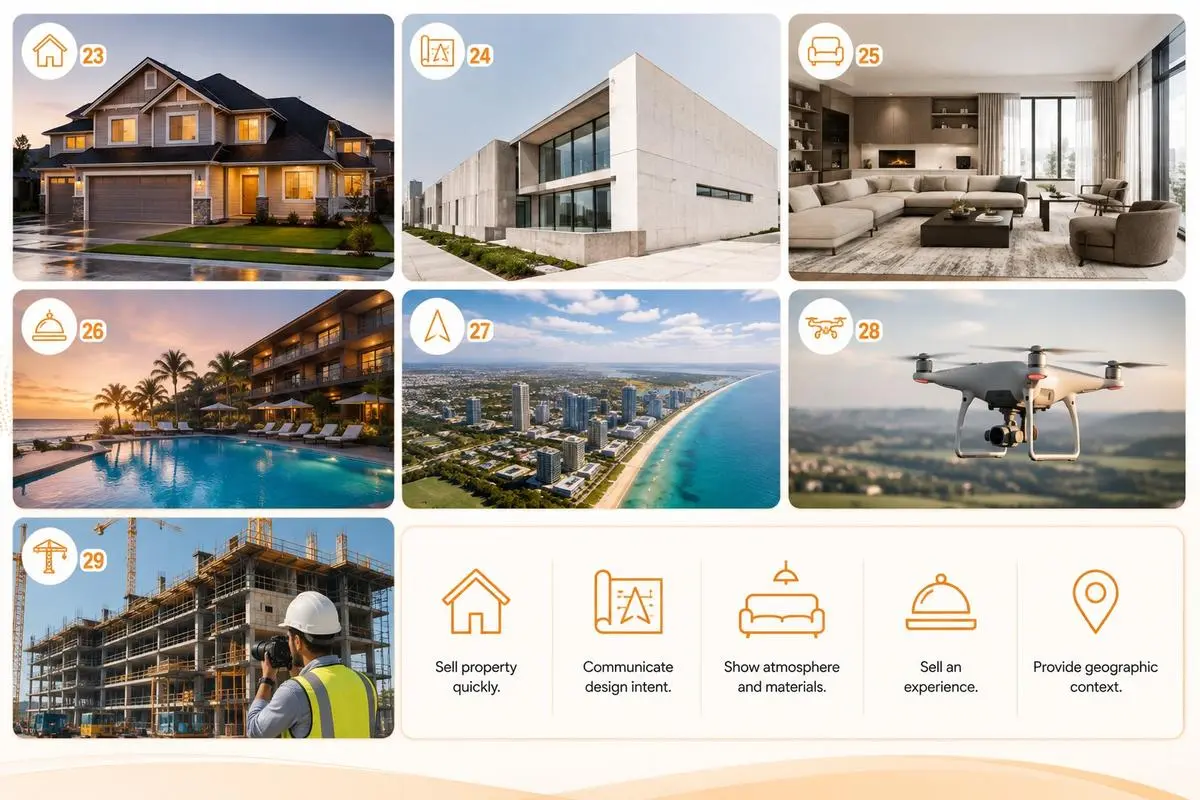
People lump these together. Clients do not. The way you shoot and edit changes completely.
23. Real Estate Photography
Marketing a house or apartment to sell or rent. Clients are agents and property managers. Interesting for fast, repeatable local work. Challenge is speed and consistency across very different homes.
24. Architectural Photography
Communicating design and structure. Clients are architects and designers. Interesting for precision and geometry. Challenge is perspective control and waiting for the right light.
25. Interior Photography
Showing atmosphere, materials, layout, and flow. Clients are designers, hospitality, and property pros. Interesting for layered lighting. Challenge is balancing windows, lamps, and ambient without losing mood.
26. Hospitality Photography
Selling an experience, not just a room. Clients are hotels, resorts, short-term rentals. Interesting for mood and lifestyle details. Challenge is making spaces feel aspirational yet honest.
27. Aerial Photography
Elevated views for context and scale. Clients are property, tourism, construction, and brands. Interesting for perspective you cannot get from ground. Challenge is weather, planning, and composition from above.
28. Drone Photography
Specific aerial approach using drones. Same clients, plus mapping and inspection needs. Interesting for unique angles at lower cost than a helicopter. Challenge is licensing, insurance, and no-fly zones.
29. Construction Photography
Documenting progress over time, often from same vantage points. Clients are builders and developers. Interesting for long-term storytelling. Challenge is safety, access, and returning consistently over months.
Real estate is about selling a property quickly. Architecture is about communicating design intent. Interior is about atmosphere and materials. Hospitality is about experience. Aerial provides geographic context that ground-level cannot.
Nature & Outdoor Photography
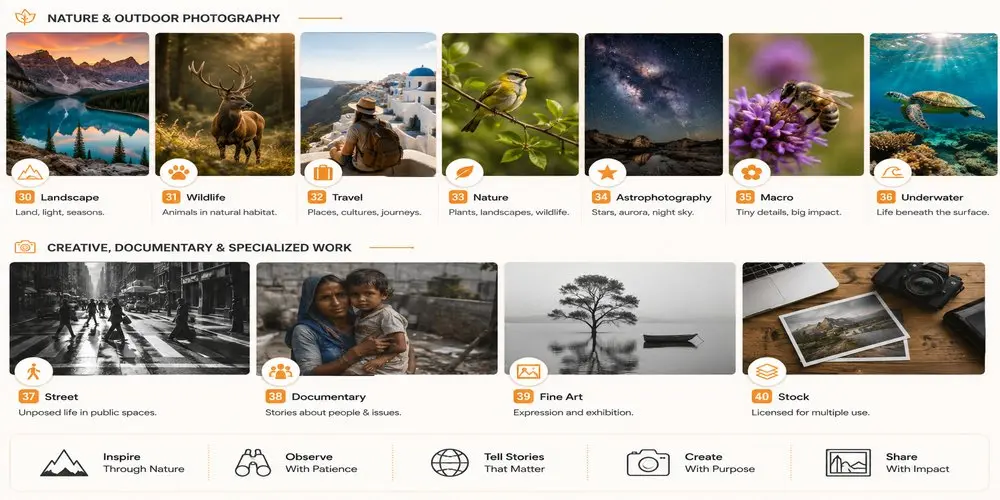
These can be deeply rewarding but they do not all operate as straightforward client-service businesses. Many are audience-driven.
30. Landscape Photography
Land, light, weather, seasons. Audience is often print buyers, tourism boards, editorial. I love the solitude of it. Challenge is income is usually indirect through prints, licensing, workshops, and books.
31. Wildlife Photography
Animals in natural habitat. Buyers are publications, conservation groups, brands, tourism. Interesting for behavior and patience. Challenge is travel cost, long waits, and specialized gear.
32. Travel Photography
Places, cultures, journeys. Buyers are tourism boards, publications, brands. Interesting for variety and storytelling. Challenge is standing out in a very saturated field.
33. Nature Photography
Broader umbrella including plants, landscapes, wildlife, macro. Similar path to landscape and wildlife, often licensing and editorial. Challenge is making common subjects feel fresh.
34. Astrophotography
Night sky, Milky Way, stars, aurora. Audience is enthusiasts, prints, workshops. Interesting for technical problem solving. Challenge is location, darkness, weather, and complex post-processing.
35. Macro Photography
Tiny subjects magnified. Clients are brands, editorial, and stock libraries. Interesting for detail most people miss. Challenge is focus, stability, and controlled light at very close distances.
36. Underwater Photography
Life and scenes below surface. Clients are tourism, diving industry, editorial. Interesting for uniqueness. Challenge is housing, safety, color loss with depth, and limited time per dive.
Creative, Documentary & Specialized Work
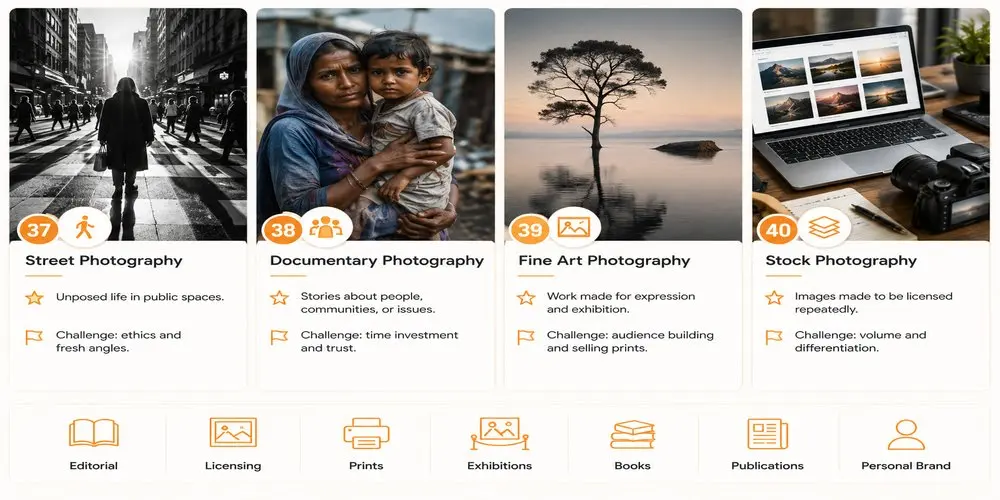
These can create value through editorial, licensing, prints, exhibitions, books, publications, personal brands, and audience building.
37. Street Photography
Unposed life in public spaces. Value is often through books, exhibitions, editorial, workshops, and personal brand. Interesting for observation and timing. Challenge is ethics and finding fresh angles in familiar streets.
38. Documentary Photography
Longer stories about people, communities, or issues. Clients are NGOs, editorial, institutions. Interesting for depth and trust. Challenge is time investment and building relationships before you shoot.
39. Fine Art Photography
Work made for expression and exhibition. Buyers are collectors, galleries, and print customers. Interesting for creative freedom. Challenge is audience building and selling prints without client briefs.
40. Stock Photography
Images made to be licensed repeatedly. Buyers are businesses and publishers needing high-quality visuals. Interesting for trend spotting and keywording. Challenge is volume and differentiation.
12 Niches Worth Exploring More Deeply
Forty options are useful for exploration. They are not useful if you are still staring at the list wondering what to choose.
Some niches illustrate very different ways of working. Let us look closer at twelve that show distinct business models and day-to-day realities.
Real Estate Photography
It is not just taking pictures of a house. I thought that when I started. Then I learned a professional property workflow can involve preparation guidance, composition that shows flow, exposure management with bracketed real estate photos, interior and exterior coverage, perspective correction, image selection, HDR blending, window balancing, object removal, sky replacement, grass enhancement, twilight conversion, aerial imagery, panoramas, virtual staging, floor plans, and delivery before 9 am next day.
That is why this niche is such a good example of where photography plus workflow plus post-production plus repeat clients matters as much as camera skill. Shooting day is fast and systematic, often 60 to 90 minutes per home, maybe three homes back to back. Editing workload is moderate per image but high in volume.
Repeat business is strong with agents who like your consistency. Difficult part is driving, dirty homes, and staying consistent when you are tired. Enjoyed by people who like systems, local commercial work, and technology.
Business model is volume-based. Natural internal link topics here include real estate photography, real estate photo editing, HDR blending, bracketed real estate photos, day-to-dusk editing, virtual staging, aerial photo editing, and photography editing workflow.
Wedding Photography
You are storyteller and logistics manager. You cover prep to reception, manage families, anticipate moments, and keep calm when timelines slip. Clients are couples. Key skills are timing, people management, low-light work, backup systems.
Day is long, physical, emotional. Editing is heavy: culling thousands, color correction across changing light, skin retouching. Repeat comes from referrals, not same couple. Difficult because no reshoots. Fits those who love emotion and pressure. Event-based model.
Portrait Photography
You direct real people to look like themselves at their best. Clients are individuals and families. Skills are lighting and coaching, especially making people comfortable quickly.
Day is session-based, usually 1 to 2 hours. Editing is skin, hair, color, background cleanup. Repeat is moderate, referrals strong. Difficult when subjects are very uncomfortable or very young. Fits people persons. Session model.
Commercial Photography
You solve business problems with images for campaigns, websites, social, packaging. Clients are brands and agencies. Skills are lighting, brief interpretation, collaboration with art directors. Environment varies from studio to location.
Editing depends on campaign but often includes detailed retouching and color accuracy for photo retouching workflows. Repeat is strong when you become a trusted vendor. Difficult part is revisions and approvals. Good for business-minded photographers. Project-based.
Product Photography
Controlled light, precise angles, perfect color. You might shoot a white background set for e-commerce photography, then a lifestyle set for social. Clients are e-commerce brands. Skills are lighting control, reflection management, dust control. Studio day, methodical, music on, tweaking by millimeters.
Editing is dust removal, reflections, color accuracy, shadow work. Repeat is excellent with catalog updates. Difficult because meticulous and repetitive. Fits those who like controlled environments. Volume or project model.
Architectural Photography
You translate design into images that respect lines and intent. Clients are architects and designers. Skills are tilt-shift or perspective control, waiting for light, careful composition. Shooting is slow, deliberate, often early morning or late afternoon.
Editing is perspective correction, exposure blending, color consistency. Repeat is moderate, portfolio-driven. Difficult because precision matters more than speed. Fits technical, patient shooters. Project model.
Corporate Photography
People and spaces for business use, from headshots to culture to offices. Clients are companies. Skills are flattering corporate lighting, quick rapport, making offices look good even on a gray Tuesday. Day is often half-day at offices, moving room to room.
Editing is clean and natural. Repeat is strong with growing companies needing regular updates. Difficult is mixed lighting and tight executive schedules. Good for relationship builders. Session plus retainer potential.
Food Photography
You make dishes look appetizing under lights before they wilt. Clients are restaurants and food brands. Skills are styling, natural-looking artificial light, texture emphasis. Day is studio or restaurant kitchen, fast because food changes quickly.
Editing is color, texture, selective retouching, cleanup. Repeat is seasonal menu updates. Difficult is styling and speed. Fits those who love detail and hospitality.
Aerial and Drone Photography
You show context impossible from ground level. Clients are property, tourism, construction, resorts. Skills are flight planning, composition from above, safety, understanding airspace. Environment is outdoors, weather dependent.
Editing is exposure, color, detail, perspective. Repeat is possible with developers and resorts. Difficult is licensing, insurance, and weather cancellations. Fits tech lovers. Project and volume hybrid.
Fashion Photography
Team-driven image making for clothing and style. Clients are brands and designers. Skills are directing models, collaborating with hair, makeup, styling, and staying on brief.
Day is long, on set, many looks. Editing is skin, color grading, campaign consistency. Repeat depends on brand relationships. Difficult is high production expectations and subjective taste.
Headshot Photography
Focused portrait work for professionals who need to look credible and approachable. Clients are individuals and companies, often in batches for teams. Skills are quick coaching, flattering light, consistency across many faces.
Day is efficient sessions or company headshot days. Editing is clean skin, background, color, light retouching. Repeat is excellent for companies with hiring. Fits those who like people and efficient systems.
Hospitality Photography
You sell a stay, not just a room. Clients are hotels, resorts, vacation rentals. Skills are interior lighting plus lifestyle details, food, amenities. Day involves rooms, lobbies, pools, details, sometimes food and people.
Editing is warm, inviting color, perspective, window balance. Repeat is seasonal and with renovations. Difficult is creating atmosphere while staying honest and on brand. Good for those who like interiors and experience.
Photography Niches That Pay Well
Everyone searches for photography niches that pay well.
Some niches have stronger commercial potential because the photographs directly support a business, event, sale, marketing campaign, or recurring operational need. That connection to revenue matters more than how hard the photo is to take.
Commercial photography can have strong potential because images are tied to sales. Wedding photography carries high emotional and logistical responsibility and one chance to get it right. Corporate photography and headshot photography serve ongoing hiring and branding needs that companies budget for.
Product photography and e-commerce photography fuel online sales every day. Real estate photography, architectural photography, and hospitality photography support property marketing cycles that never stop.
Fashion photography and food photography drive campaigns and menus where visuals drive decisions. Aerial photography offers specialized perspective with fewer qualified providers in some markets.
For each, ask why the client places commercial value on images. Is it speed? Trust? Making a team look credible? Making a property look market ready? Reducing time to market for a product? The more directly your work connects to a business outcome, the easier it is to price sustainably. Profitability varies by city, client type, experience, specialization, and how efficient your workflow is.
High Revenue Does Not Automatically Mean High Profit
This one took me too long to learn.
Photographer A charges $1,500. Sounds great on Instagram. Job requires long travel, an assistant, equipment rental, extensive editing, several revisions, multiple days of back and forth.
Photographer B charges $600. Project is nearby, fast, repeatable, simple to edit, easy to deliver with a standard workflow.
Second project may be more attractive economically.
Profitability = revenue minus real costs minus time. Time has value. When you evaluate profitable photography niches, track shooting time, travel, editing, software, gear wear, insurance, marketing, and communication. A $600 job that takes three hours total with a client who books quarterly can beat a $1,500 job that eats your week.
This is why photographers should evaluate revenue per project plus time plus expenses plus repeat potential rather than simply asking how much does this niche pay.
Which Niche Fits Your Personality?
If you love working with people, consider portraits, weddings, headshots, family, events. You get energy from interaction and coaching.
- If you prefer controlled environments, consider product, food, still-life-style work, commercial studio photography. You like tweaking light for 20 minutes and seeing the difference.
- If you like pressure and fast decisions, consider sports, weddings, events, photojournalism. One chance, quick reflexes, no hesitation.
- If you prefer solitude, consider landscape, wildlife, astrophotography, fine art. You are happy waiting alone for light and do not need a client clapping after every shot.
- If you enjoy business and client relationships, consider real estate, commercial, corporate, hospitality, product. You like talking about goals, repeat needs, and campaigns.
- If you enjoy technical workflows, consider architecture, real estate, aerial, panorama, commercial. Gear, stitching, perspective correction, and precision excite you.
Think of this as a mini self-assessment, not a rulebook.
The Elimination Method
Instead of asking what is the best photography niche, remove poor fits.
Imagine you consider weddings, wildlife, real estate, product photography, portraits.
Do you hate working under pressure with no reshoot? Wedding photography may not fit.
Do you dislike travel and expensive gear and long periods without income? Wildlife may not fit.
Do you like controlled lighting and reshoots? Product photography becomes more interesting.
Do you enjoy people and immediate feedback? Portraits may rise.
Do you want recurring commercial clients in your own city? Real estate may deserve investigation.
The right niche often becomes clearer when you remove the wrong ones. Write down eight options you like. Eliminate three based on lifestyle, two based on economics, one based on skills you do not want to learn. You are left with two test candidates. That is manageable.
Passion vs Profit
Passion-first: Choose what you genuinely love. You will practice longer, which matters. Risk is ignoring whether anyone pays regularly.
Market-first: Find a problem people already pay to solve, like property photography for agents or headshots for companies. Risk is burnout if you dislike the work.
Hybrid: Combine something you enjoy with something commercially useful. Love people and systems? Headshot days for startups. Love design and technical work? Architecture and interiors. Love food and light? Restaurant photography.
Hybrid is practical for most photographers building a sustainable photography career. It respects both motivation and market. It also leads to better photography business ideas because you are not forcing yourself into something you hate.
The 30-Day Photography Niche Test
Do not rebuild your whole website around a guess. Test before building your entire career around it.
Week 1 – Research: Identify real clients near you, study their needs, understand deliverables, observe competing offers. What does a real listing include? What does a restaurant expect for menu photography? What does a company headshot day look like?
Week 2 – Practice: Create sample work exactly like paid work, test equipment, practice lighting, test editing. Time yourself from import to export. Note where you get stuck. This tells you about your photography workflow gaps.
Week 3 – Market: Contact potential clients, show relevant samples, ask questions, track responses. You are gathering data, not begging for bookings. Are people curious, polite but distant, or silent?
Week 4 – Evaluate: Score enjoyment, skill, demand, inquiries, expenses, editing time, repeat potential, lifestyle fit. Be honest.
This is not about finding instant success. It is about gathering evidence before making a major commitment. That evidence is more useful than any article.
Your Portfolio Should Show the Niche You Want
Do not make potential clients guess what you specialize in.
If you want restaurants, show food. Property clients, show property. Corporate clients, show people in professional environments. Brands, show commercial work. Weddings, show complete wedding stories, not just detail shots.
A focused 20-image portfolio can communicate more clearly than 200 unrelated photographs. That is a practical portfolio principle, not a law, but it works. Use niche-specific galleries, case studies, before and after examples, and short project descriptions. A good photography portfolio looks like the job you want next.
This is also where internal topics like photography portfolio tips, photography business, photography topics, and how to start a photography blog naturally fit, because you will need to show work intentionally, not randomly.
The Hidden Cost of a Niche: Editing
Choosing a photography niche also means choosing a post-processing workload.
The work does not end when the shutter closes. This is especially important for photographers choosing a commercial niche where consistency and turnaround are part of the service.
Once you handle larger volumes of commercial or property work, repetitive post-production can become a bottleneck. I hit this point when I had three property shoots in one day and realized I would be up until 2 am doing sky replacements.
Many photographers choose to outsource parts of that workflow while focusing more on shooting, client communication, scheduling, sales, marketing, relationship building, and business development.
That is where specialized support fits into a photography editing workflow. For example, Real Estate Photo Enhancement for consistent property image presentation. HDR Editing for balancing bracketed exposures.
Object Removal for distracting items that need to be cleaned from property images. Day-to-Dusk / Twilight Editing for creating evening-style exterior marketing imagery. Aerial Photo Editing for improving consistency in drone and property imagery. Virtual Staging for helping present vacant spaces with furnished concepts. Panorama Stitching & Editing for wide interior or property views.
Floor Plan Editing for property marketing materials. Sky and Grass Replacement for improving exterior presentation where appropriate. Virtual Renovation for illustrating possible design transformations.
Companies like PixelShouters have built services around those exact workflows. Photographers working in volume-based fields often integrate such help to keep turnaround fast and quality consistent, while keeping creative control and client relationships.
The value is not just retouching, it is reclaiming time for shooting and growth. For those documenting process, showing how you handle editing workflow can also become useful content.
Can You Have More Than One Niche?
Yes. Most working photographers do. The trick is labeling them so clients do not get confused.
Primary niche is what you want people to know you for. This drives your headline and main gallery.
Adjacent niche is a closely related field. Real estate to architecture to hospitality. Portraits to headshots to personal branding. Wedding to engagement to family.
Experimental niche is a creative area you are still exploring without business pressure.
Adjacent niches often share equipment, skills, clients, locations, workflows. That sharing is what makes them sustainable compared to juggling three unrelated photography business ideas that each need different marketing.
Beginners can explore broadly. They do not have to permanently label themselves on day one. As inquiries grow, specialization makes marketing and referrals easier. Established photographers can keep a primary niche while exploring secondary work in separate galleries or brands. Clarity sells, but curiosity keeps you growing.
When a Niche Becomes a Rut
Specialization helps you get better. It can also make every shoot feel identical.
Signs you are slipping into a rut: every shoot feels identical, you stop experimenting, you photograph only what clients request, you feel creatively bored, technical improvement has slowed, you dread sessions you used to like.
Solutions: personal projects with no client, monthly creative challenges, different subjects, new lighting techniques, collaborations, experimenting outside the paid niche, studying other photography genres for inspiration. Shoot film for a month. Use one lens for ten sessions. Assist someone in a different niche.
Your business can be specialized while your creativity stays broad. That is how you avoid burnout and keep your work fresh.
Common Mistakes
- Choosing a niche because it looks glamorous on Instagram. Fashion looks glamorous. Real days are early call times and revisions.
- Choosing only based on money. Profit without enjoyment is hard to sustain, especially when editing piles up.
- Copying another photographer. Their niche works for their city and network, not automatically yours.
- Ignoring local demand. Liking it is not enough if no one nearby pays regularly.
- Ignoring editing time. If you hate detailed retouching, product work will drain you fast.
- Buying too much gear too early. Rent until a niche proves itself and actually generates photography income.
- Building an unfocused portfolio. Show the job you want, not everything you have done since 2019.
- Underpricing. Low prices create unsustainable work and attract price shoppers who never return.
- Never testing the niche with real clients. Assumptions feel safe, conversations give data.
- Depending on one client. One big client feels secure until they leave or pause.
- Ignoring business costs like software, insurance, travel, and marketing.
- Choosing a niche that does not fit your lifestyle. Weekends free and wedding photography rarely mix.
- Becoming creatively bored because you stopped personal work entirely.
- Confusing revenue with profit. Track time and expenses honestly for a month and you will see.
- Trying to serve everyone. “I shoot everything” tells clients nothing about why they should hire you.
Turning a Niche Into a Photography Business
Skill to Portfolio to Offer to Client to Workflow to Pricing to Repeat Business
Skill is competence in core tasks. Portfolio is relevant proof, not a museum of everything. Offer is a defined deliverable, not vague photography services. Client is who you actually contact and listen to.
Workflow is repeatable from inquiry to delivery, including culling, editing, and file handling. Pricing accounts for real costs and time and profit, not just what you saw someone else charge. Repeat business is the reason clients return, like fast turnaround, consistent editing, or seasonal updates.
Choosing a niche is the first step. Turning it into a system is what creates a photography business that can support you. Many photographers get stuck after portfolio. They forget workflow and repeat business are what pay rent.
Different Niches Use Different Business Models
Session-based: Portraits, families, headshots. You sell time slots. Marketing is about filling a calendar and getting referrals.
Event-based: Weddings, events, sports. You sell coverage of a date that cannot move. Systems and stamina matter more than anything.
Project-based: Commercial, advertising, architecture. You sell a brief with usage and deliverables. Proposals and licensing matter.
Volume-based: Real estate, school, catalog and e-commerce photography. Lower fee per unit, high volume, extreme efficiency. Your systems make or break you.
Licensing-based: Stock, editorial, commercial licensing. Create once, license many times. Less predictable but scalable.
Product-based: Prints, books, artwork, fine art photography. You sell physical or digital products from your images.
Retainer-based: Brands, businesses, hospitality. Ongoing availability for regular needs. Stable income, deeper client relationships.
Two photographers can shoot different subjects but run surprisingly similar businesses. Compare models, not just topics. Do you want calendar-driven personal work or system-driven volume work? That answer narrows photography field choices faster than scrolling through more types of photography.
FAQ
What are photography niches?
Photography niches are specific combinations of subject, audience, service, and purpose. A genre like portrait photography becomes a niche when you define who you serve, what problem you solve, and how you deliver.
What photography niches pay well?
Those where images directly support a business need with recurring budgets. Commercial photography, wedding photography, corporate photography, product photography, real estate photography, architectural photography, hospitality photography, fashion photography, headshot photography, food photography, and aerial photography can have strong commercial potential, but profitability depends on costs, workflow, and repeat business.
What is the best photography niche for beginners?
One with low barrier, clear local demand, and fast feedback. Often headshot photography, portrait photography, or real estate photography, because you can practice, build a focused portfolio quickly, and talk to real clients without huge investment.
How do I choose a photography niche?
Discover options, compare how the day feels, evaluate against enjoyment, skill, real need, economics, repeat potential, and lifestyle. Then run a 30-day test with research, creation, client conversations, and evaluation. That process answers how to choose a photography niche better than any quiz.
Can I have more than one photography niche?
Yes. Primary for reputation, adjacent for related clients and shared skills, experimental for creativity. Real estate to architecture to hospitality, or portraits to headshots to personal branding, work well together.
Is real estate photography a good niche?
It can be if you like systems, speed, and local recurring work. It benefits from efficient workflow including HDR blending, panorama stitching, and add-ons like virtual staging and floor plans. Profitability varies by market and volume.
Is wedding photography profitable?
It can be, but revenue is not profit. Long days, heavy culling and editing, backup responsibility, and client communication must be priced in. Profit comes from accurate pricing and referrals.
Is product photography a good niche?
Yes if you enjoy control and detail. E-commerce needs constant product photography. Success depends on lighting, color accuracy, reflection management, and efficient post-processing.
Which photography niche has the most demand?
Depends on location. Most markets have steady need for headshot photography, real estate photography, product photography, food photography, and event photography because businesses and property professionals need images continuously.
Should I choose passion or profitability?
Look for hybrid overlap. Passion keeps you practicing, profitability keeps you in business. The sustainable spot is where interest, skill, demand, economics, and lifestyle overlap.
Can I change my photography niche?
Absolutely. Many photographers evolve from generalist to specialist to hybrid as skills and markets change. Skills transfer more than you think.
How long should I test a photography niche?
30 days for real data, 60 to 90 days to see early traction. Less than that is not enough to learn workflow, client communication, and editing reality.
Conclusion
You started with a library full of everything. That is not a failure. That is exploration. Everyone who takes photography seriously goes through that phase.
Choosing among photography niches is not about finding one magical answer that solves everything forever. It is about finding overlap between what you enjoy, what you are good at, what people need, what makes economic sense, and what fits your life.
Test it. Build a small portfolio that looks exactly like the job you want. Talk to real photography clients. Measure what happens, including editing time and expenses. Adjust your offer, your workflow, your pricing.
Your business can have a direction while your creativity stays broad. That is the point. You pick a path so clients can find you, and you keep exploring so you stay inspired to keep walking it.
Pick a direction for the next 90 days. Not forever. Just long enough to gather evidence. The right photography niche is not the one you dream about most. It is the one you can actually do, enjoy doing, and keep doing while building a sustainable business around it.