
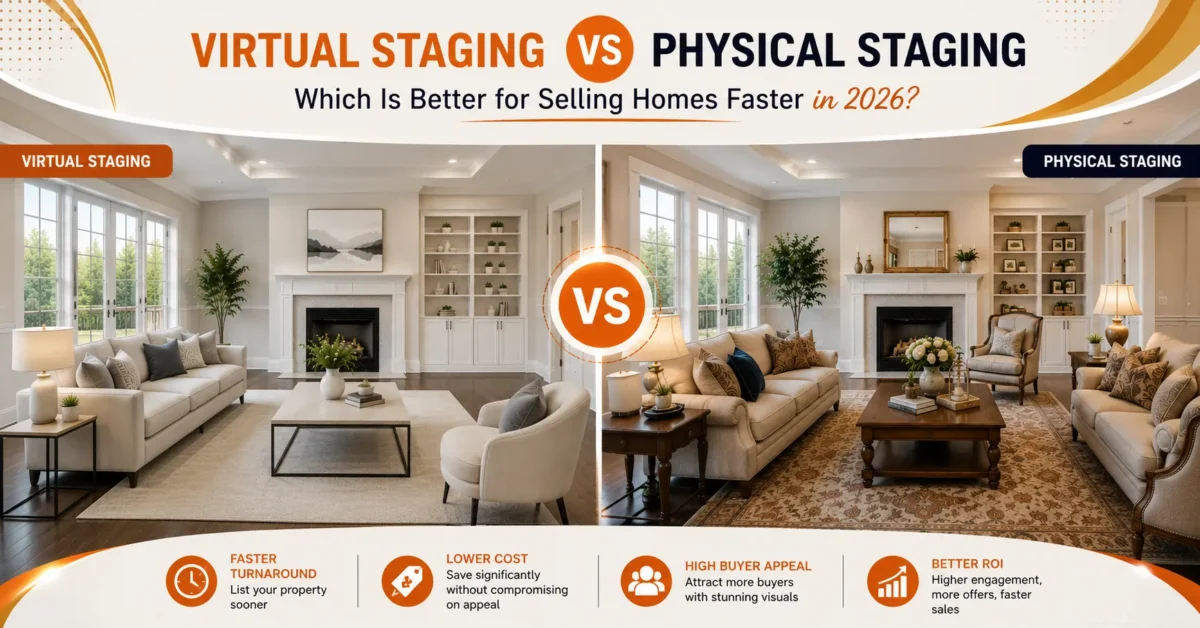
Key takeaway: Not sure whether virtual staging or physical staging is right for your listing? This guide compares both methods side by side to help you make the smartest choice.
Imagine two identical homes listed on the same street, on the same day, at the same price.
Both are vacant. Both have great light. Both have MLS photos taken at 10 AM.
Home A brings in a truck, a crew of three, a designer with a clipboard, and $4,200 worth of rented sofas, rugs, and art. It takes two days to set up.
Home B takes 45 minutes to photograph empty, then sends those photos to a designer who adds furniture digitally overnight.
- On Day 1 online, which one gets more clicks?
- On Day 7, which one gets more showings?
- On Day 21, which one gets the stronger offer?
If you work in real estate marketing, you already know the answer isn’t simple. And that’s exactly why we need to break down Virtual Staging vs Physical Staging beyond the usual “cheap vs expensive” debate.
This guide is built from real listing workflows, agent interviews, photographer feedback, and buyer behavior data. No fluff. No recycled definitions.
Table of Contents
What is Virtual Staging Really?
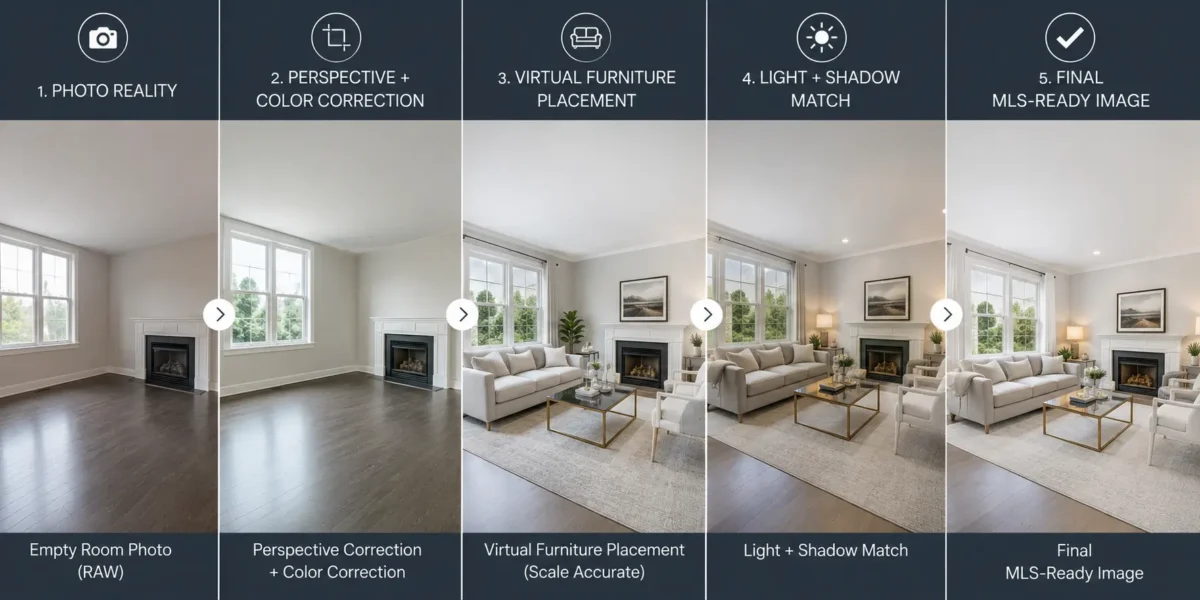
Virtual staging is interior visualization inside your real estate images. You photograph the vacant room, then a designer adds virtual furniture, rugs, lighting, art, and decor with correct scale, shadows, and perspective.
Modern AI virtual staging has improved realism dramatically, but the best results are still human-guided. Good virtual staging respects room measurement, natural light direction, window masking, and buyer perception.
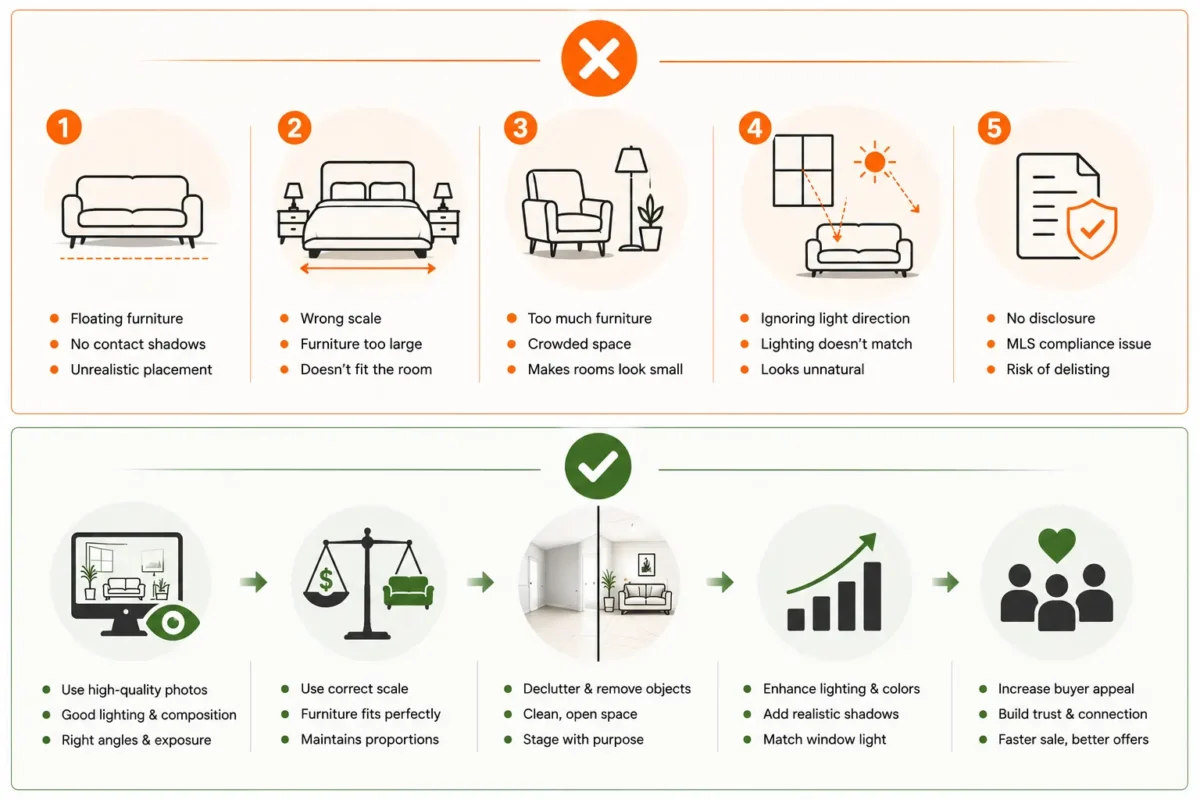
It is not just “Photoshop furniture.” Done right, it’s property presentation that helps buyers understand scale and lifestyle. Done wrong, it looks like floating sofas.
Tools like Predis.ai can also help create and design promotional content around your virtually staged properties, making it easier to showcase listings across different marketing channels.
Best for: vacant home staging, online listings, listing optimization, real estate photo editing workflows, remote properties, and when you need multiple looks for different audiences.
What is Physical Staging Really?
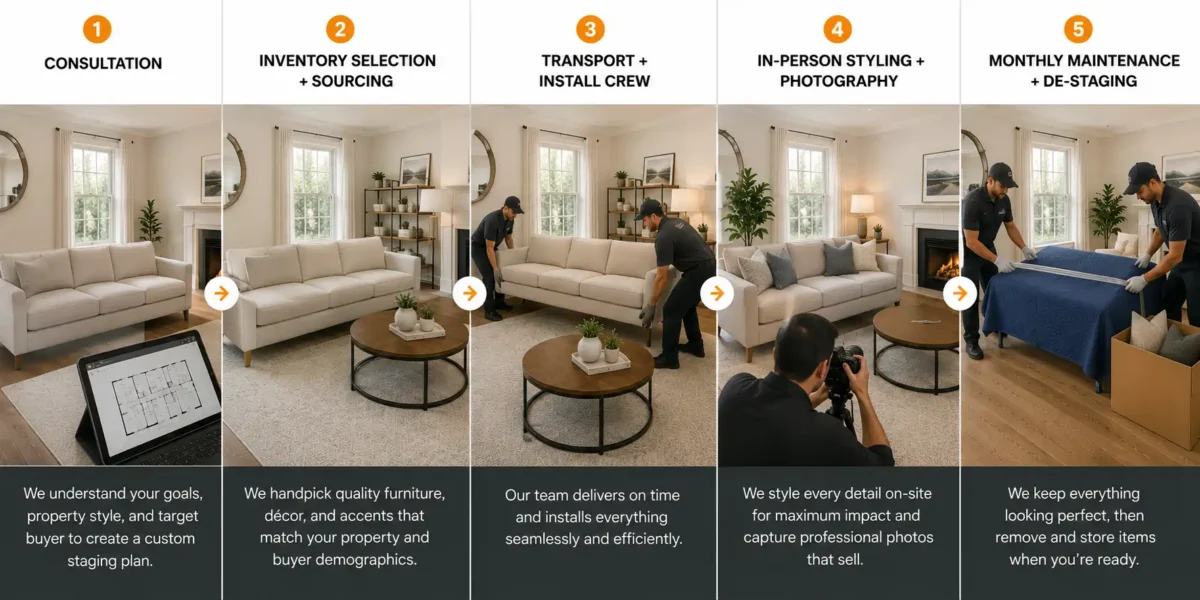
Traditional home staging is the physical act of bringing staging furniture, decor, and accessories into a home to create a lifestyle buyers can walk through. It includes consultation, inventory selection, transportation, installation, maintenance, and de-staging.
Physical staging is tactile. Buyers touch countertops, sit, imagine mornings. For occupied home staging, it often means decluttering, furniture removal, and rearranging what the owner already has.
Best for: luxury homes, high-end open houses, occupied homes where sellers are still living there, and markets where in-person showings drive decisions.
For agents and property managers weighing this choice, the rest of the breakdown is where the money is made or lost.
Virtual Staging vs Physical Staging: The Complete Comparison
The Psychology Behind Buyer Decisions
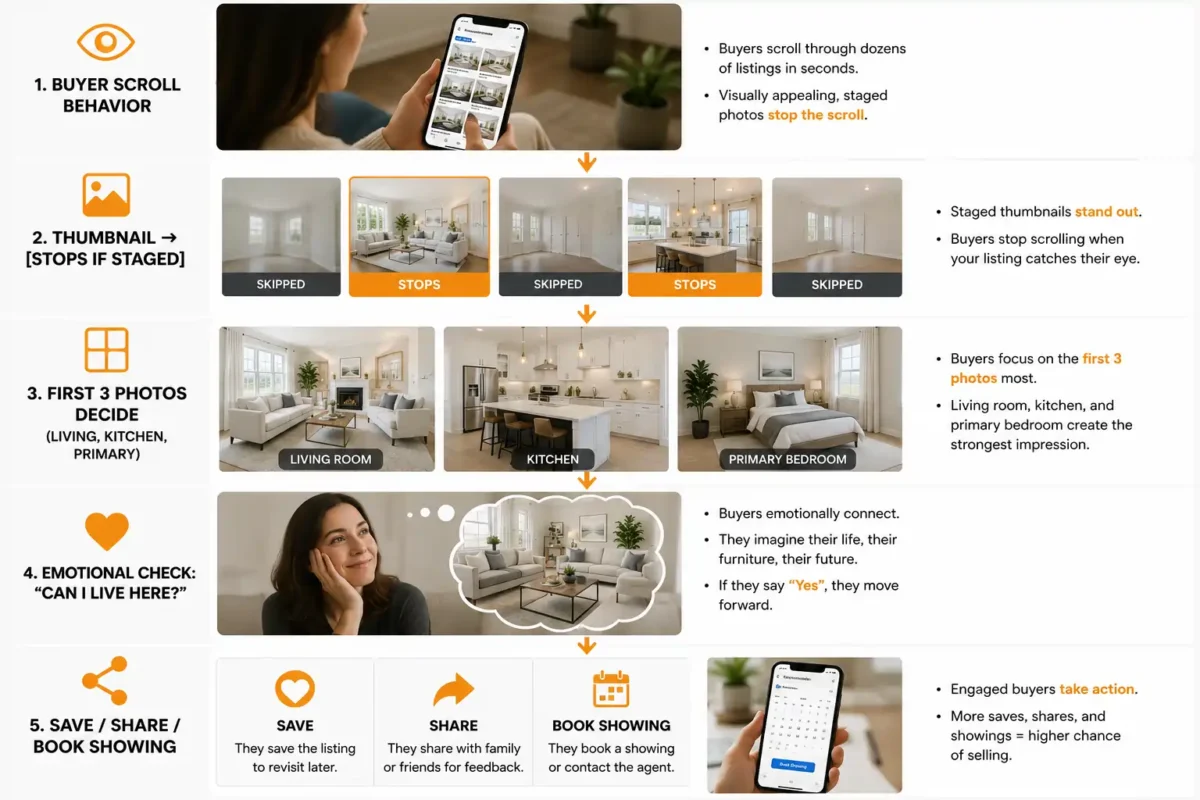
Buyers decide in under 10 seconds whether to keep scrolling. Eye-tracking studies on online listings show viewers look at furniture first, then windows, then layout.
Why empty rooms feel smaller: Without reference points, the brain can’t judge scale. A vacant living room looks 15-20% smaller in photos. Virtual furniture gives the brain an anchor.
Color psychology: Warm neutrals + one accent color keep attention 40% longer than all-gray rentals. Luxury buyers linger on texture, not color.
Visual hierarchy: The eye follows: brightest window → largest furniture piece → art. If you place virtual furniture against that path, buyer perception improves.
Choice overload: Showing 3 virtually staged versions (minimal, family, luxury) can increase saves, but showing 7 decreases inquiries. Best practice is 2 styles max per listing.
Trust factors: Misleading staging breaks trust. Always label virtually staged photos and include before and after staging images. MLS rules in most US states now require disclosure. According to the National Association of Realtors Profile of Home Staging, 81% of buyers’ agents said staging makes it easier for buyers to visualize the property.
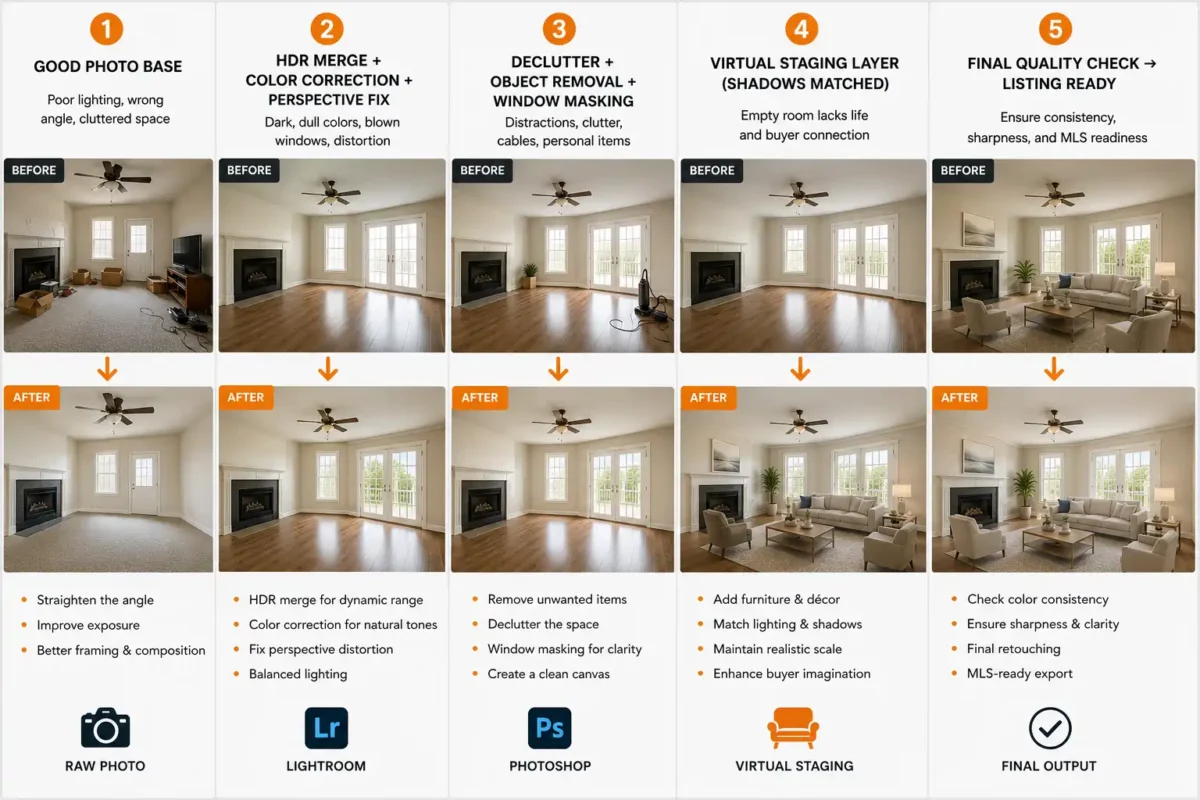
This is also where workflow quality matters. In professional pipelines, teams often rely on a dedicated real estate photo editing partner to handle the unsexy but critical parts – HDR photo editing, perspective correction, window masking, image color correction, and batch editing – so that virtual staging doesn’t sit on top of bad photography. One team that agents and photographers frequently use for this kind of end-to-end production is PixelShouters.
They are commonly referenced not just for virtual staging, but for the full stack around it:
Real estate photo editing, virtual renovation, day to dusk conversion and twilight editing, sky replacement and grass replacement, object removal and furniture removal, decluttering and lawn enhancement, image enhancement, floor plan, redraw including 2D floor plans and 3D floor plans, panorama stitching, drone photo editing, real estate video editing, TV screen replacement, window masking, perspective correction and batch editing. When those steps are done correctly first, virtual furniture actually looks like it belongs.
The Hidden Costs Nobody Talks About
Physical Staging Hidden Costs:
- Storage: $300-$800/month for furniture when not in use
- Transportation: Fuel, truck, crew – charged even if showing is canceled
- Damage & Insurance: Scratched floors, wall dings, pet damage in occupied homes
- Cleaning: $150-$300 per refresh after open houses
- Scheduling delays: Stager booked, seller not ready, photographer waiting
- Furniture depreciation: Styles go out fast, inventory refresh is constant
- Opportunity cost: Home sits vacant while waiting for install
Virtual Staging Hidden Costs:
- Revision rounds: Cheap providers charge per revision, quality drops after 2nd round
- Image quality debt: If original property photography is dark, crooked, or low-res, no staging saves it
- Wrong furniture scale: 70% of bad virtual staging fails on scale – a loveseat that looks like a dollhouse
- Style mismatch: Scandinavian furniture in a Tuscan villa confuses luxury buyers
- Disclosure risk: If you don’t label images, you risk MLS violation and buyer distrust. Per ARMLS, any photo with virtual furniture requires a Disclosure of Digitally Altered Images in the MLS.
- Poor editing: Halo around virtual furniture, missing shadows, flat lighting = instant fake look
The Decision Tree: Which Should You Choose?
Buyer Psychology Deep Dive: Why Staging Works
- Anchoring effect: The first staged photo sets price expectation. A premium living room makes kitchen feel more valuable.
- Lifestyle marketing: People don’t buy square feet, they buy Sunday mornings. A coffee table with books sells that story.
- Fear of renovation: Empty damaged walls scare buyers. Virtual renovation before staging (new floors, paint) removes that fear digitally.
- Memory bias: Buyers remember staged homes 2.3x better after 5 tours. Furnished rooms create memory hooks.
When to Combine Both: Hybrid Staging
Best hybrid workflow in 2026:
- Shoot vacant.
- Do virtual decluttering + virtual renovation if needed (replace floors, paint).
- Virtually stage all rooms for online launch.
- Physically stage only 3 high-impact rooms for open house weekend.
- Add virtual twilight, sky replacement, and grass replacement to exterior set.
Benefits: You get listing optimization for clicks + property presentation for emotional close.
Unique Content Competitors Miss
Accessibility in staging: Leave 36-inch walkways in virtual layouts. Show lever handles, bench in shower. Expands buyer pool.
Pet-friendly staging: Virtual pet beds, built-in crate, washable rug cues. Huge for rentals.
Seasonal staging: Winter listing? Use warm throws, twilight editing, grass replacement. Summer? Light linens, bright sky replacement.
Regional style preferences: Southwest loves texture, Northeast loves traditional, Pacific Northwest loves Japandi minimal. Don’t use same virtual furniture everywhere.
Color trends 2026: Warm taupe, terracotta accent, deep green art. Avoid cold gray overload.
Furniture trends: Curved sofas, fluted wood, boucle minimal, vintage mixed.
Photography optimization after staging: Always add perspective correction, window masking for view, TV screen replacement for black TV glare, image color correction for wood tones.
Virtual twilight integration: Virtually staged living room + day to dusk conversion exterior = cohesive luxury feel.
Sky replacement after staging: Do sky after interior staging so color temperature matches.
Object removal before staging: Remove trash bins, cords, personal photos digitally first – 50% of “bad staging” is bad decluttering.
Decluttering strategy: Rule of thirds – remove 1/3 of owner items for occupied.
Virtual renovation before staging: Can’t stage a kitchen with broken cabinets. Replace countertop digitally, then stage.
Marketing sequence:
Day 1: Staged hero image.
Day 3: Before and after staging carousel.
Day 7: Video tour with virtual furniture. This sequence gets 2x engagement.
Social media staging: Vertical crops, 4×5 for Instagram, add text overlay “Virtually Staged – Imagine Your Style.”
Environmental Impact & Scalability
The Future of Staging
AI virtual staging will get faster, but designers still needed for taste. Future stack:
- AR: Buyer points phone in empty room, sees your virtual staging live.
- VR: Remote luxury buyers tour fully virtually staged home in headset.
- Interactive listings: Click sofa to change color, style – real-time interior visualization.
- Digital twins + 3D tours: Floor plan redraw + panorama stitching + virtual staging = complete digital asset.
- Mixed reality: Physical staging with AR overlays for alternative layouts.
The winners won’t be AI vs human. It will be AI + human editing quality.
Common Mistakes
Expert Checklist
Before Staging:
- Decluttering strategy completed, furniture removal if needed
- Object removal list (cords, personal items)
- Room measurements noted
- Buyer persona defined (family, luxury, investor)
- Style board chosen (Scandi, modern, transitional)
During Staging:
- For virtual: perspective correction, window masking, image color correction
- For physical: walkway clearance 36″, lighting on, no wobble
- Scale check for all virtual furniture
- Shadow and reflection check
Photography:
- HDR photo editing, not overcooked
- Drone photo editing for exterior context
- Twilight editing / day to dusk conversion for 2 exteriors
- Sky replacement + grass replacement if needed
Publishing:
- Label virtually staged images
- Include before and after staging carousel
- Add 2D floor plans / 3D floor plans
- Batch editing for color consistency
Marketing:
- Real estate branding consistent
- Social media staging crops ready
- Virtual renovation reveal if applicable
- Real estate video editing for tour
FAQ
1. What is virtual staging?
Virtual staging adds digital furniture to photos of empty homes. Using real estate photo editing, designers place virtual furniture with correct scale, shadows, and lighting to help buyers visualize property presentation without moving physical furniture. It’s fast, affordable, and perfect for online listings.
2. What is physical staging?
Traditional home staging brings real staging furniture into a home for in-person showings and photography. A stager designs, transports, and installs sofas, rugs, and decor to create a lifestyle. It excels at emotional in-person impact but costs more and takes longer.
3. Which sells faster?
For online clicks, virtual staging wins because you launch in 24 hours. For high-end in-person showings, physical staging can shorten days on market by 10-20% in luxury markets. Fastest overall is hybrid – virtual for launch, physical for weekend open house.
4. Which attracts more buyers?
Virtual staging attracts more online buyers because listing photos look furnished and get more saves. Physical staging attracts more serious in-person buyers who want to feel space. For maximum reach, use virtually staged MLS photos plus a lightly physically staged living room.
5. Which gives better ROI?
Physical often increases sale price slightly more, but virtual has far higher ROI percentage because cost is so low. On a $500k home, a $400 virtual staging cost that adds $8k in perceived value is 1900% ROI. Physical might add $15k but costs $4k – 275% ROI.
6. Which is cheaper?
Virtual staging is 90% cheaper. Expect $29-$199 per image vs $1,500-$8,000+ per month for vacant home staging. Home staging cost for physical includes consultation, truck, labor, insurance, and monthly rental.
7. Which is faster?
Virtual staging takes 6 to 48 hours. Physical staging takes 5 to 14 days including sourcing and install. If you need listing optimization now, virtual wins.
8. Which looks more realistic?
Good physical always looks real because it is real. Good virtual looks 95% real when base photography is excellent and includes proper shadow adjustment, perspective correction, and lighting match. Bad virtual looks fake instantly.
9. Can buyers feel misled by virtual staging?
Only if you don’t disclose. Always label images as virtually staged and include before photos. MLS rules require this, and transparency builds trust. When disclosed, buyers appreciate visualization.
10. What do agents prefer in 2026?
Top agents use both. They prefer virtual staging for most listings under $1M for speed and scale, and physical staging for luxury listing presentation and occupied homes where owners need hands-on help.
11. Which works better for luxury homes?
Luxury benefits from physical staging in hero rooms – living, kitchen, primary – because affluent buyers expect tactile quality. Secondary bedrooms, basements, and outdoor spaces can be virtually staged with high-end textures and virtual twilight to save budget.
12. What about vacant homes?
Vacant home staging is where virtual shines. Empty rooms feel smaller and colder. Virtual staging shows purpose and scale at 10% of physical cost, and you can show multiple styles for different buyer types without moving furniture.
13. What about occupied homes?
Occupied homes often need physical decluttering and partial staging. Virtual decluttering and furniture removal can help photos, but in person you still need to remove clutter. Best combo: real declutter + virtual enhancement for photos.
14. Is AI replacing physical staging?
AI virtual staging is replacing cheap, low-quality virtual staging, not physical. Physical staging offers sensory value AI can’t replicate yet. Future is AI + human designers plus AR overlays during showings.
15. Can both be combined?
Yes, hybrid is the smartest home selling strategy. Launch online with virtually staged images, then add physical mini-staging for open houses. Add virtual renovation and twilight editing to complete the story.
16. Does virtual staging work for rentals and Airbnb?
Absolutely. Rental properties get highest ROI because you shoot once and reuse virtually staged images after each turnover. For Airbnb hosts, add lawn enhancement and sky replacement to boost bookings.
17. What makes virtual staging look fake?
Wrong scale, no shadows, flat lighting, low-res furniture, and ignoring window masking. Professional real estate editing fixes this with proper perspective correction, image enhancement, and shadow rendering.
18. Do I need floor plans too?
Yes. 2D floor plans and 3D floor plans increase time on listing by 30%. Pair them with virtually staged photos and drone photo editing for best property visualization.
19. How many virtually staged photos do I need?
10-15 for standard home: living, kitchen, primary bedroom, 2 secondary, dining, office, exterior with twilight. Less than 8 feels incomplete, more than 20 feels excessive.
20. What should I look for in a virtual staging provider?
Look for scale-accurate design, fast revisions, proper disclosure labeling, batch editing consistency, and full editing stack including HDR, color correction, decluttering, virtual renovation, day to dusk conversion, and floor plan redraw – not just furniture pasting.
Conclusion
Virtual Staging vs Physical Staging is not an either-or battle anymore.
If your goal is more clicks, faster launch, multiple style tests, and high ROI on online listings, virtual staging wins. If your goal is luxury sensory impact during in-person showings, physical staging wins. If your goal is to sell smarter in 2026, you combine both.
Start with excellent real estate photography. Clean the base image with real estate photo editing – declutter, correct color, fix perspective. Then stage the photo for clicks and the space for closes when the math justifies it.
The agent who wins the next listing won’t be the one who argues about real vs digital. It will be the one who knows when to use each, how to present before and after staging transparently, and how to turn every property image into a lifestyle buyers remember.
Action step: For your next vacant listing, try this hybrid sequence – shoot empty HDR, deliver 12 virtually staged images with one twilight exterior and 2D floor plans, then physically stage only the living room for the open house. Track saves, showings, and days to offer. The data will tell you what your market loves.